
O God of my righteousness!
Answer me when I call, O God of my righteousness! – Psalms 4:1
Psalms 4:1-3
1 Answer me when I call, O God, my vindicator! Though I am hemmed in, you will lead me into a wide, open place. Have mercy on me and respond to my prayer!
2 How long will you people ruin my reputation? How long will you make groundless accusations? How long will you continue your lies?
3 You can be sure of this: The LORD set apart the godly for himself. The LORD will answer when I call to him.
Literature and history are replete with examples of vindicators. But what exactly is a vindicator, and what role do they play? In essence, they advocate for others, demonstrating their innocence or righteousness. They absolve individuals from blame, suspicion, or uncertainty. Vindicators often stand up for the right, seek justice, or fight for those wrongly accused.
In fiction, Zorro is the hero of the people. The Jedi of Star Wars fight for the right. Superman fought for truth, justice, and the American way. Atticus Finch in “To Kill a Mockingbird” acts as a vindicator for Tom Robinson, a black man wrongly accused of a crime within a society plagued by racial bias. The prophet Amos spoke out against injustice and advocated for righteousness when ancient Israel was in deep moral decline.
The term vindicator comes from Latin, derived from the verb vindicare, which means to liberate, act as an avenger, protect, and defend. The Latin phrase Deo vindice is translated as God as defender/protector.
Who is the ultimate vindicator?
God, our heavenly Father
As David prays in times of distress, he refers to his Father God as “God of my righteousness.”
A superficial read of this verse is somewhat confusing. Why? Because we focus On what righteousness israther than what righteousness does. The Father is righteous, and He always acts righteously. How does the Father act in a righteous way?
David shows the way. He pleads with the Father as “God of my righteousness.” It is an appeal to God’s character as an upholder of justice and His covenant, a protector of His own. (Kidner). David is in dire straits. He is eager to be vindicated and purposely invokes God with the epithet, “God of my vindication” (Dahood).
A layman’s paraphrase of the sense of Psalms 4:1 might read, Father, you have always protected me; you always have my back. Once again, I am in trouble, and I need your help. Answer my desperate cry for help.
Psalms 4 is a declaration of confidence in the Father. It reveals David’s close walk throughout his lifetime. The Father has come through for him before, and David has the confident expectation that He will again.
REFLECT & PRAY
“God wants us to come ‘boldly’ into His presence, not timidly or anxiously or in fear of how He might respond. He wants to help us, and He has all the grace we need to confront any challenge we might face” (Stanley).
Father what a privilege and delight it is a child of the King. You are my vindicator, and You always have my back. You encourage me to come to You during my times of need with the expectation that You will respond in the nick of time.
INSIGHT
The term “righteous” is not simply a characteristic or attribute of God the Father. He is truly the embodiment of righteousness.
The Hebrew word for righteousness is sedeq. Sedeq is a legal term that means defense or vindication against the charges brought by one’s accuser. Briggs translates the phrase as “the God who vindicates his cause against his adversaries and establishes his right.” The NJV translates as “maintainer of my rights.” “In some languages, one may reverse the order of the two clauses and say, ‘O God, you are my defender. So please listen to me and help me when I pray’” (UBS).
Sedeq “expresses the relation between God and His people. It signifies more than an absolute standard or norm. True, God is righteous in Himself, but His righteousness is expressed as He relates to His people, as a father to His children. He has promised them His presence and victory over adverse circumstances” (VanGemeren).
David learned a tremendous open secret. “Faith in God’s righteousness is based on God’s covenant promise that He will come to the rescue of His children in need. Calling boldly on God is a privilege that belongs to His children” (VanGemeren).
God always does what is right! He defends those in need. He protects His own. And He does it with delight and joy. He is our Dad.
Thus, David boldly cries out to his Father God, “Oh God, my righteousness.” What David does, any child of the King can do. It is our privilege as members of God’s Forever Family.
Hebrews 4:16 So let us come boldly to the throne of our gracious God. There, we will receive his mercy, and we will find grace to help us when we need it most.
What does it mean when the author of Hebrews writes, “in time of need” or “when we need it most?” The Greek word here is eukairos. Eukairos is derived from eú– well, good, and kairós – time. It has the sense of opportune time, well-timed, favorable, or suitable time.
G. Campbell Morgan writes, “I am never tired of pointing out that the Greek phrase translated ‘in time of need’ is a colloquialism of which ‘in the nick of time’ is the exact equivalent. ‘That we may receive mercy and find grace to help in the nick of time – grace just when and where I need it. You are attacked by temptation. At the moment of assault, you look to Him, and the grace is there to help in the nick of time. There is no postponement of your petition until the evening hour of prayer. But there in the city street with the flaming temptation in front of you, turn to Christ with a cry for help, and the grace will be there in the nick of time.”
Ephesians 3:12 Because of Christ and our faith in him, we can now come boldly and confidently into God’s presence.
“As a result of Christ’s work and our union with Him, we now have the unspeakable privilege of entering into God’s presence at any time, in full confidence of being heard, and without any fear of being scolded (MacDonald). Our boldness is the respectful attitude and absence of fear we have as children addressing their Father. Our access is our liberty to speak to God in prayer. Our confidence is the assurance of a welcome, a hearing, and a wise and loving answer. And it is all through faith in Him, that is, our faith in the Lord Jesus Christ” (MacDonald).
John Fitzgerald Kennedy Jr. was born at Georgetown University Hospital on November 25, 1960. It was two weeks after his father and namesake, Senator John F. Kennedy of Massachusetts, was elected president. His father was sworn in as president two months after John Jr. was born.
A journalist mistakenly heard JFK repeating his son’s name, “John,” in quick succession, which led to the widespread but unofficial nickname “John-John.”
During the initial three years of his existence, John Jr. resided in the White House. He was known for his bold and frequent visits to his father’s office. He often was seen scrambling around or sitting beneath the imposing Resolute desk in the Oval Office.
All children of the King share the same privilege. We are welcome to come boldly into the Father’s throne room and sit on His lap whenever we so desire. He gladly receives us because we are His children, and He is our Dad.
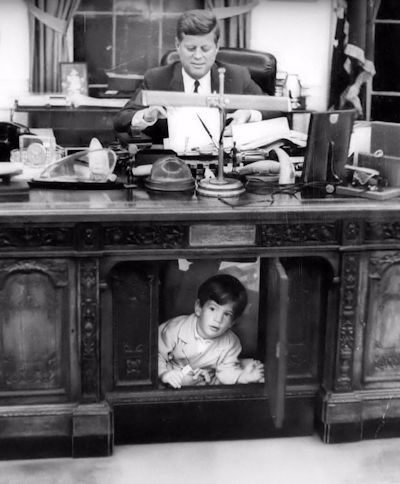
John-John, under his dad’s desk
God is never in a hurry, but He’s always on time!
¯\_(ツ)_/¯
© Dr. H 2024
 Dr H Reflections