
Blind justice ∙∙
He will judge the world with justice and rule the nations with fairness. – Psalms 9:8
Psalms 85:10 Lovingkindness and truth have met together; Righteousness and peace have kissed each other.
Jeremiah 23:5 “For the time is coming,” says the LORD, “when I will raise up a righteous descendant from King David’s line. He will be a King who rules with wisdom. He will do what is just and right throughout the land.”
In contemporary society, justice is often symbolized through images or illustrations as a blindfolded woman holding a balance scale and a sword pointing upwards. This imagery suggests that justice should be blind to biases, aiming for fairness, impartiality, and equality. It implies an ideal where decisions are made without regard to an individual’s nationality, ethnicity, religion, skin color, or gender.
Traditionally, and regrettably still prevalent today, the concept of justice has been simplistic: the principle that “Might makes right.” This notion, enduring through the ages, posits that those with wealth and power are unaccountable, essentially becoming the law themselves.
Where did their power and control come from? Power dynamics, defined by various factors such as wealth, familial background, religion, race, ethnicity, gender, and social status, have historically dictated what is deemed right and wrong, creating a divide between the “haves” and the “have-nots” and fostering an uneven playing field and systemic injustices.
Before the “woke” movement emerged, social justice was understood as active social engagement – feeding the hungry, caring for neighbors, and volunteering time and resources to aid those less fortunate. This definition emphasized acts of kindness and community support.
However, the “woke” reinterpretation of social justice introduces a new perspective. Influenced by Marxist principles, it critiques the notion of private ownership and frames societal issues primarily as conflicts between those with power versus the powerless. This contemporary approach to social justice seeks to challenge power imbalances and rectify systemic inequalities.
This perspective perpetuates the optimistic hope that the government can fix everything. It suggests that improvements for the powerless will follow by surrendering personal freedoms and properties to state control. However, this raises questions about the implications for the “haves.” What happens to those with wealth, power, or status? Things do not work out too well for them. They are to become disenfranchised.
Advocates of a “woke” approach to social justice often recommend an equitable redistribution of wealth and assets as a solution. They argue that such measures would achieve social justice and pave the way for a utopian society. Yet, it’s worth taking a moment to consider the effectiveness of these strategies. Ask yourself, how well has this worked out anytime, anywhere, in the world? Have these strategies ever resulted in a fair and just society?
REFLECT & PRAY
“True peace is not merely the absence of war but the presence of justice.” This statement has been attributed to Jane Addams, a pioneering social worker, activist, and Nobel Peace Prize laureate (1931). However, it is more commonly associated with Martin Luther King Jr.
Father thank You for being just and righteous. You defer to no one. Your absolutes in the Word of God provide a firm foundation for life, law, governance, fairness, and justice.
INSIGHT
It was rare to find laws with universal accountability outside the Scriptures, such as those seen in the Ten Commandments or the Torah. Civilizations such as Egypt, Assyria, and China operated under legal systems emanating from the decree of absolute monarchs or sovereigns. Hammurabi’s code stood out as an early attempt at codifying laws. Ancient Greeks and Romans also developed legal standards of conduct. Although every culture had its own set of rules, not all were universally applied to every member of society.
Viewed through a “woke” lens critical of societal inequities, many social issues are traced back to foundational injustices within societal frameworks. These injustices often stem from poverty and unequal distribution of resources. Francis Schaeffer articulated this by pointing out that “‘unjust social structures’ and in particular ‘the maldistribution of wealth’ are the real causes of evil in the world.”
In a theistic worldview, there is a God who exists. He created all that is and created people with whom He can interact. Without this type of God, there are no absolutes; everything is arbitrary. “Might makes right!”
But the Father has an entirely different way for society to function. He has provided absolute standards of right and wrong, good and evil, found in the Word of God. Societies based on absolutes derived from the Scriptures have a legal framework and a consensus within which they function. For Americans, this is expressed in one phrase from the Pledge of Allegiance, which was added in 1954: “One Nation under God.”
Biblical justice rests upon the absolute truth of the word of God. Because of absolute truth, justice, and impartiality, every person may be viewed with an unbiased lens.
Justice is not blind. It is impartial. Everyone is judged based on the Father’s absolutes and principles derived from them. Judges are bound to make objective decisions based on the law. No favoritism is permitted. Those who serve as witnesses or defendants swear before God “to tell the truth, the whole truth and nothing but the truth.”
This revolutionary approach to justice, characterized by its impartiality and adherence to absolute truth, was unprecedented in the world until it emerged during the Reformation in sixteenth-century northern Europe.
The Reformation laid the groundwork for a society that gave rise to freedom without chaos or capriciousness in Western European nations that adopted its principles. It positioned the Scriptures as the core foundation for morality and legal frameworks.
In 1905, Paul Robert unveiled his mural “Justice Lifts the Nations” in Lausanne, Switzerland, within the stairwell of the old Supreme Court Building. This artwork served as a daily visual prompt for judges heading to their courtrooms, reinforcing that justice is insightful and grounded in the divine absolutes provided by the Father God.
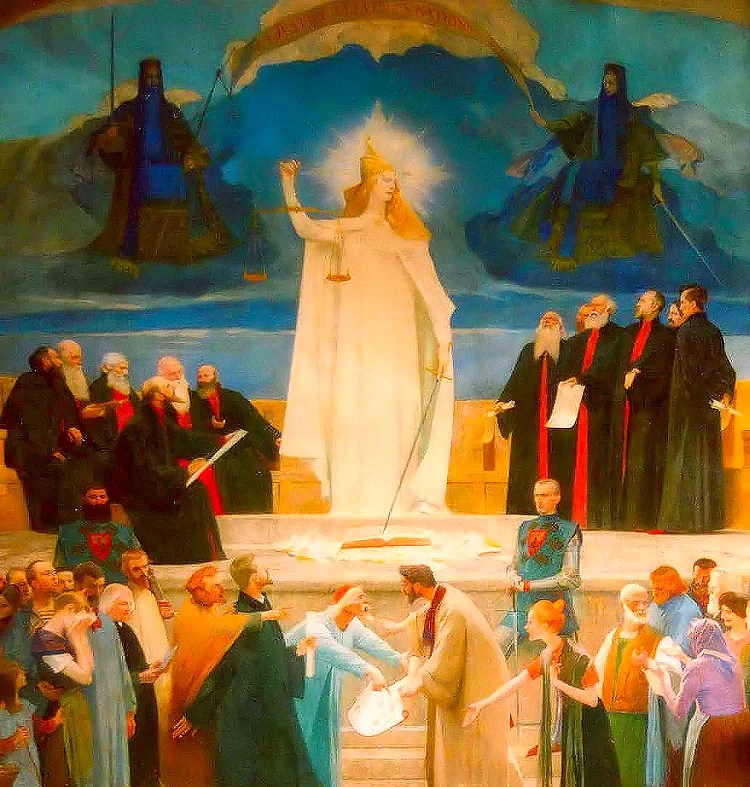
The mural presents Justice as a figure of a woman without a blindfold. She is holding a scale of balances and a sword. Her sword is not pointed vertically upward but downwards towards a book inscribed with the words “The Law of God.” This artistic choice emphasized to judges that their rulings should be anchored in unchanging truth rather than society’s transient or arbitrary norms.
Various legal scenarios in the foreground of the artwork illustrate the diversity of cases judges encounter. The mural’s overarching message is straightforward yet profound: God’s law is the basis for justice and freedom.
¯\_(ツ)_/¯ 12-30-1
© Dr. H 2024
 Dr H Reflections