Out Damned Spot
“Come now, and let us reason together,” Says the LORD, “Though your sins are as scarlet, They will be as white as snow; Though they are red like crimson, They will be like wool.” – Isaiah 1:18
Isaiah 1:15-18
15 When you lift up your hands in prayer, I will not look. Though you offer many prayers, I will not listen, for your hands are covered with the blood of innocent victims.
16 Wash yourselves and be clean! Get your sins out of my sight. Give up your evil ways.
17 Learn to do good. Seek justice. Help the oppressed. Defend the cause of orphans. Fight for the rights of widows.
18 “Come now, let’s settle this,” says the LORD. “Though your sins are like scarlet, I will make them as white as snow. Though they are red like crimson, I will make them as white as wool.
In July 2024, the Israel Antiquities Authority (IAA) announced the discovery of a rare 3800-year-old woolen textile scrap in the “cave of skulls” in the Judean desert. The scrap contained strands of scarlet-colored threads, ranging in color from orange to pink to crimson. They were woven through uncolored linen to form a tabby, a type of simple, plain weave fabric where the weft thread crosses the warp thread alternately to create a checkerboard or latticelike design. The weft threads featured a vibrant red color and were woven in between the undyed warp threads.
Radiocarbon dating determined the textile’s age, placing it in the Middle Bronze Age (1954-1767 BC). This remarkable discovery was a testament to the exceptional preservation of perishable materials in the hyper-arid, low-humidity conditions found in the Middle East. This unique preservation allowed the cloth to survive for nearly 4000 years within the cave, retaining its distinctive scarlet coloring.
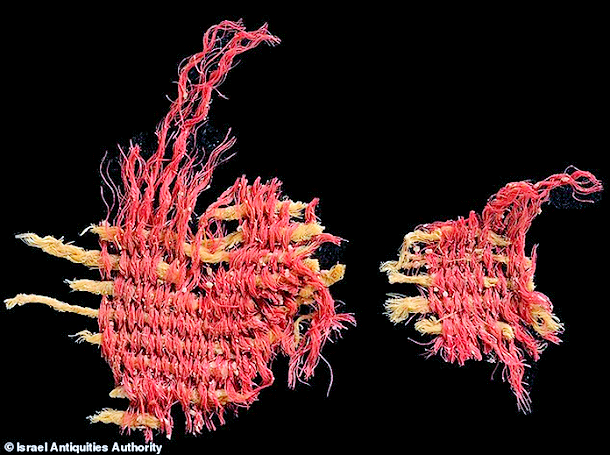
The red dye was created from the carcasses and eggs of a scarlet-colored scale insect. The female kermes or cochineal scale insects attach themselves to the kermes oak. The females and their eggs produce carminic acid, which provides the red/scarlet color. The scarlet dye is referred to as shani (crimson) or tola’ath shani (crimson worm or scarlet worm).

Scarlet Worm
Shani, being crimson/scarlet red, is the color of blood. Thus, the term shani was employed as a simile for blood. Blood was often used as a metaphor for wrongdoing, murder, and guilt.
Isaiah 1:15 When you lift up your hands in prayer, I will not look. Though you offer many prayers, I will not listen, for your hands are covered with the blood of innocent victims.
REFLECT & PRAY
Genuine prayer mirrors a meaningful conversation between two individuals. The act of God and man engaging in dialogue represents the essence of prayer (Stanley).
Father, thank You for providing a way for the scarlet stains of my life to be washed away, leaving no trace behind. Thank You for giving me the ability to think clearly, come to my senses, and settle things according to Your terms.
INSIGHT
In Isaiah 1:15, the Father admonishes the nation of Israel, stating that their worship attempts were unacceptable due to the presence of “bloodguilt” on their hands. The Father will not listen to their prayers. He will ignore them until things are made right. They must be cleansed and then cease from evil.
A word about “bloodguilt.”
The term “bloodguilt” is a concept that lacks a direct equivalent in English. It encompasses the idea of guilt that is the result of the wrongful shedding of blood, particularly the guilt associated with the death or murder of an innocent person. It could be translated as “guilt of blood” or “the guilt of innocent blood. “Blood guilt” could be incurred under various circumstances, such as when an undeserving individual was killed. Such acts resulted in an “enduring sense of guilt,” that is, “indelible guilt.”
Dried blood and crimson stains are tough to remove. How could people held liable for “bloodguilt” ever do it? As impossible as it might seem, the Father will make it happen. In Isaiah 1:18, He invites anyone struggling with “bloodguilt” to come to Him for cleansing.
Isaiah 1:18 Says the LORD, “Though your sins are like scarlet, I will make them as white as snow. Though they are red like crimson, I will make them as white as wool.”
The Father promises to remove the blood and the guilt associated with it, promising to treat them as he would a scarlet garment. Anyone who has tried to clean dried blood knows how difficult it is, but not so for the Father. As hopeless as it might seem, He can make even the most stubborn crimson stains disappear as if they had never existed. Miraculously, the figurative garments will become white, pure, and pristine, appearing as if they were never stained at all.
The symbolism here is clear. When we are indeed guilty of sin, we cannot cleanse ourselves; it requires supernatural intervention. Our sins will not just be covered up, still present beneath a façade. Instead, they will be removed and replaced by spiritual and moral purity. The sins that are now as obvious as the color red will be washed away and those who are sinful will be transformed.
The Father has found Israel guilty and is offering them the opportunity to be forgiven and restored. However, this forgiveness and purification can only occur if the people repent and change their ways. The Father is a forgiving God, but only on His terms.
The people were mistaken in thinking that they could live as they pleased as long as they made restitution through sacrifice. Instead of relying on religious rituals, they were supposed to obey God and have the right attitude toward Him and others (John A. Martin).
King David understood this and showed us the way. When Nathan confronted him regarding his sin with Bathsheba and the subsequent murder of Uriah, it soon became front-page news. He humbled himself and pleaded with the Father. He threw himself upon God’s mercy, utterly dependent upon His loving kindness and grace. He came to the Father on His terms.
Psalms 51:1-4
1 Have mercy on me, O God, because of your unfailing love. Because of your great compassion, blot out the stain of my sins.
2 Wash me clean from my guilt. Purify me from my sin.
3 For I recognize my rebellion; it haunts me day and night.
4 I have sinned against you, and you alone; I have done what is evil in your sight. You will be proved right in what you say, and your judgment against me is just.
He is haunted by the guilt of his sin, no doubt brokenhearted, and has abused and sullied his close, loving relationship with the Father.
David’s bloodguilt is like that of Lady Macbeth. Undone, haunted, and plagued by her own conscience, Lady Macbeth utters one of the most recognizable phrases coined by Shakespeare: “Out, damned spot.” She’s constantly washing her hands, trying to cleanse the imaginary blood that only she can see. They are stained with the invisible blood of her guilt from conspiring with her husband to kill Duncan and seize the throne of Scotland.
While it did not turn out well for either Macbeth or Lady Macbeth, David fared much better. He prostrated himself before the Father and was marvelously cleansed from his grievous, premeditated bloodguilt.
Psalms 51:7 Purify me from my sins, and I will be clean; wash me, and I will be whiter than snow.
What is true of David is true of any child of the King. No matter how grievous or horrendous our sin, we can come to the Father and be cleansed and forgiven.
How?
The Father Himself offers forgiveness and absolution.
Isaiah 1:18 “Come now, and let us reason together,” Says the LORD,
At face value, the Father wants to work things out and urges His people to consider their position before Him. The Father does not explain how the transformation will take place; only that He will ensure it happens. The resolution and restoration of fellowship between the Father and His people hinge on His capacity to cleanse them of their sins. (Isaiah 1:18) and the people’s willingness to turn from sin and rebellion against God to faith and obedience (Gary V. Smith).
Cleansing and forgiveness for the deepest, most vile guilt imaginable is precisely what the Father does. This is why Christ Jesus came into the world.
1 Timothy 1:15 Christ Jesus came into the world to save sinners – and I am the worst of them all.
¯\_(ツ)_/¯
© Dr. H 2024
 Dr H Reflections