
Grace and the Bug ∙
Everything God created is good. – 1 Timothy 4:4
Genesis 1:27, 31
27 So God created human beings in his own image. In the image of God, he created them; male and female, he created them.
31 Then God looked over all he had made, and he saw that it was very good!
On September 9, 1947, a team at Harvard University, composed of engineers and computer scientists, encountered an issue with the Mark II computer, which was persistently malfunctioning and producing incorrect results. Upon investigation, what did they discover? They uncovered a literal “bug” – a moth had infiltrated the computer’s physical structure and lodged itself between the relay contacts, disrupting the machine’s electronics. This incident is noted as the discovery of the first computer bug. At 3:45 p.m., Grace Murray Hopper documented this occurrence in the computer’s logbook, attaching the moth with a note that read, “First actual case of bug being found.”
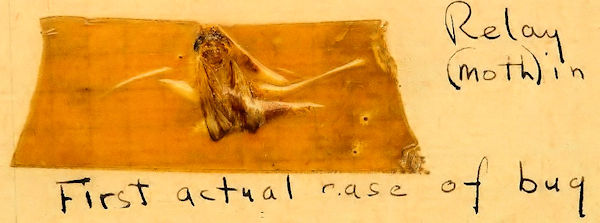
The term “bug,” referring to a defect or glitch in a system, dates back to the 1800s, with Thomas Edison reporting “bugs” in his inventions. Edison played a crucial role in popularizing this term in the context of technological faults.
In the field of Information Technology, a “bug” is defined as an error or flaw in a computer program or hardware system, as noted by Techopedia. Bugs can cause unexpected results or make a system act unpredictably, representing any deviation from the intended design. Programmers must debug their code to ensure it functions as expected, as most bugs stem from human error.
Adam and Eve were pure, innocent, holy, and righteous, devoid of any sin. There were no flaws in the original design. As the Father examined His creation work, He continuously affirmed its goodness (Genesis 1:4, 10, 12, 18, 21, and 25). After the creation of Adam, He declared that everything He had created was very good (Genesis 1:31). “A verdict on the totality of Creation, now completed” (Sarna). The Father does not make mistakes. All of His creation was perfect.
If this indeed was the case, what changed? Was something added unexpectedly? Not at all; instead, something was removed.
The situation can be likened to light and darkness. The Creator didn’t create darkness; He created light. Darkness is simply the absence of light (Genesis 1:2-4).
Similarly, the Father didn’t create sin. Human sin represents the absence of innocence, purity, and holiness. When Adam and Eve chose to disobey the Father by eating the fruit from the tree of knowledge of good and evil, their autonomous choice was an act of sin. It was then that the first “bug” was introduced into the human race. This bug wasn’t a moth; it was sin.
REFLECT & PRAY
Contemplate the grandeur and complexity of the cosmos while simultaneously recognizing the meticulous detail and delicateness of His fingerwork. Marvel at the beauty of the night sky while acknowledging the profound care with which it was designed. How awesome is our Father God!
Father, thank You for debugging me and welcoming me into Your Forever Family.
INSIGHT
Everything the Father created was inherently good. Each phase of creation was affirmed as good, and upon completion, He declared it all to be very good, with no imperfections in the human race.
Genesis 1:31 Then God looked over all he had made, and he saw that it was very good!
How good was it? What does this goodness entail, and what does good mean?
The Hebrew word for “good” is tov. In the Old Testament, particularly in Genesis, tov has a broad meaning, encompassing what is happy, beneficial, aesthetically pleasing, morally right, preferable, of superior quality, or utmost value. The Hebrew word tov suggests something desirable, enjoyable, beautiful, correct, delightful, or positive.
In Genesis, “good” denotes anything that enhances, supports, or promotes life. The Father’s creation is deemed good because He Himself is good, and His goodness is evident in all His works (NET, notes). Genesis 1:31 “affirms the consummate perfection of God’s creation” (Sarna).
For the infinite, all-powerful, all-knowing, eternal Father God, the act of creation was merely a display of His craftsmanship. It was effortless for Him; He spoke, saying, “Let there be,” and so it was.
Psalms 19:1 The heavens declare the glory of God, and the sky above proclaims his handiwork.
Job 40:15-19
15 Take a look at Behemoth, which I made just as I made you. It eats grass like an ox.
16 See its powerful loins and the muscles of its belly.
17 Its tail is as strong as a cedar. The sinews of its thighs are knit tightly together.
18 Its bones are tubes of bronze. Its limbs are bars of iron.
19 It is a prime example of God’s handiwork, and only its Creator can threaten it.
Indeed, He used His fingers! Such intricate fingerwork requires precision and care, not raw power. Consider the precision needed by an eye surgeon performing cataract surgery or the delicate tasks neonatologists perform.
Psalms 8:3 When I look at the night sky and see the work of your fingers – the moon and the stars you set in place.
The starry expanse is described as the fingerwork of God, suggesting that creating the heavens was as effortless for Him as making something with one’s fingers is for a person, rather than using their entire body. It took minimal effort (Constable).
Once the bug of sin infiltrated humanity, each person needed to be individually “debugged.” This crucial task became the responsibility of the Lord Jesus Christ, the Savior of the world.
The necessary action was not easy, but it was straightforward. The eradication of sin from human hearts, minds, and spirits was accomplished through the redemptive work of the Lord Jesus Christ. This operation was exceedingly expensive, more than any mere mortal could ever pay. What was the price? It cost the Lord Jesus Christ His life.
John 3:16 For God so loved the world, that he gave his only Son, that whoever believes in him should not perish but have eternal life.
Whoever accepts His sacrifice is debugged and becomes part of the Father’s Forever Family. Consequently, they become as though they had never sinned.
John 1:12-13
12 But to all who believed him and accepted him, he gave the right to become children of God.
13 They are reborn – not with a physical birth resulting from human passion or plan, but a birth that comes from God.
He died upon a cross of wood Yet made the hill on which it stood!
¯\_(ツ)_/¯9-13-1
© Dr. H 2024
 Dr H Reflections
Well, DrH: I’m required to give credit when due. Amplifying the meaning of the word good in Genesis by translating the Hebrew word tov was very appropriate in this case. I have always thought that the word good was a little weak if we are expected to understand that all creation was in the state of absolute perfection or superlative. Even very good is inadequate, in my opinion.
Why did translators use the word good?
Bernie
Sent from my iPhone
LikeLike
The Old Testament Hebrew presents a unique challenge for translators. It has around 8,000 vocabulary words, significantly less than modern English, which has approximately 600,000 words listed in the OED. This difference means that a single Hebrew word can be translated into multiple English words, a phenomenon known as polysemy. The precision and richness of the English language help us navigate this complexity, providing a nuanced and comprehensive translation that captures the full meaning of the original Hebrew text.
The meaning of words is derived from their usage in written materials. This can be quite confusing. For example, the English word “trunk” can refer to a tree trunk, luggage, a car, an elephant, the human body, or even clothing.
It’s important to recognize that many ancient languages are not necessarily simple. In fact, they can be quite complex in their own unique ways. However, their surviving written materials often have a limited vocabulary. As cultures mature, so do their languages, leading to the proliferation of new vocabulary terms.
DrH
LikeLike