
Rembrandt – Painter of the Soul ∙
The Pharisee stood by himself and said, “I thank you, God, that I am not a sinner like everyone else. For I don’t cheat, I don’t sin, and I don’t commit adultery. I’m certainly not like that tax collector” – Luke 18:11
Isaiah 6:5 Woe is me, for I am doomed, for I am a sinful man. I have filthy lips, and I live among a people with filthy lips. Yet I have seen the King, the LORD of Heaven’s Armies.
Rembrandt Harmenszoon van Rijn, simply known as Rembrandt (1606–1669), widely regarded as one of the greatest artists of the Dutch Golden Age, earned the title “The Dutch Painter of the Soul.” What made Rembrandt stand out among the gifted artists of his era was his uncanny ability to capture the depth of human emotion, inviting viewers not only to observe but feel the stories he painted.
One of the hallmarks of Rembrandt’s work was his masterful use of light and shadow. He often employed a technique where light seemed to emerge from the surrounding darkness, imbuing his compositions with a profound sense of mystery and transcendence. This interplay of illumination created a three-dimensional quality as if the scene reached out toward the viewer. Light sources in his works—whether a humble candle, a radiant window, or the divine glow emanating from the face of Christ—served more than a practical purpose. They symbolized spiritual revelation, truth, and grace. A stunning example of this is his painting “The Supper at Emmaus,” where the face of Jesus radiates a celestial light, drawing the viewer into a moment of divine encounter.
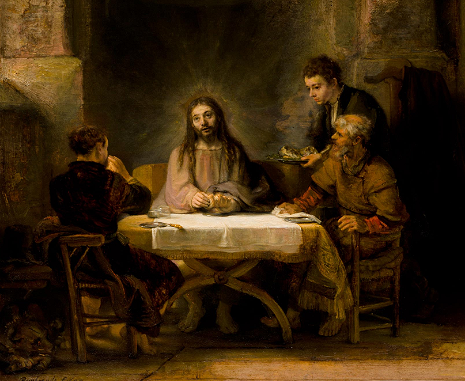
Rembrandt’s deep connection to the Bible, inspired by the stories his mother read to him as a child, shaped the heart of his art. He didn’t merely illustrate Scripture—he entered into it. As an artist and as a man, he saw himself not separate from the flawed and sin-ridden characters on the canvas but as one of them. Laurel Gasque observed. “Rembrandt not only read the Bible, he participated in it. He identified with all the characters he portrayed, knowing he was a sinner in need of redemption.” Rembrandt’s art became a way for him to explore and express the grace of God revealed through Jesus Christ.
Painting His Own Story
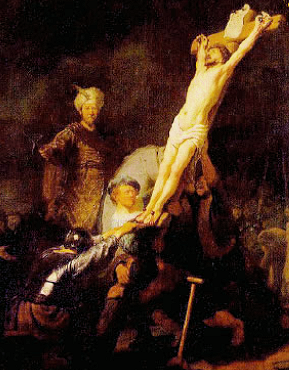
Perhaps most compelling was Rembrandt’s habit of inserting himself into his paintings. His self-portrait emerges in numerous biblical compositions, subtly or boldly, as a visual confession of his need for grace. For instance, in The Raising of the Cross, he shows himself in contemporary clothing, wearing a painter’s beret at the foot of the cross. Through this self-insertion, Rembrandt declared that Christ’s sacrifice was deeply personal—Christ died for him.
Rembrandt’s life itself bore the marks of human frailty and divine grace. He wasn’t a stranger to failure. His extravagant lifestyle led him into financial ruin, and his struggles appeared in his work. One of his rawest confessional pieces, The Prodigal Son in the Tavern, features a self-portrait of Rembrandt as the wayward son, squandering his inheritance in worldly indulgence. Through his art, he acknowledged his faults, his brokenness, and his need for redemption.
Joining the Story
Rembrandt painted biblical scenes as living, breathing realities instead of distant myths or idealized fables. And as children of the King, we are invited into the same story. The Bible is not just a historical record—it’s a mirror reflecting our own souls. When we see its characters wrestle with life’s trials, we must ask ourselves, how would we respond? Will we distance ourselves, rationalizing, “I am not that bad? Comparatively speaking, I’m better than most. Hey, God’s just lucky to have me.”? Are we tempted to think ourselves superior, like the Pharisee in Luke 18, who prayed, “I thank God that I am not a sinner like everyone else.”?
Or will we allow Scripture to lead us into self-examination and find ourselves coming up short? Do we enter into the sorrow and pathos or the joy and worship showcased in the Scriptures? Will we, like Isaiah, come face to face with God’s holiness and see ourselves as we truly are—imperfect, unclean, and deeply in need of grace?
“Woe is me! For I am lost; for I am a man of unclean lips.” – Isaiah 6:5
Isaiah’s confession was not born of despair but of revelation. He didn’t see himself as he truly was until he encountered the Father’s excellent majesty. It was then that he realized his faith was shallow and insincere. Seeing God opened the eyes of his heart.
“For the first time, he sees that he’s typical of his generation, whose faith was unthinking and glib. Their mouths were not filled with seraphic worship but with flippant repetitions and self-justifying excuses. But now Isaiah sees himself because he sees God. And something new is entering his heart – humility” (Ortlund and Hughes).
REFLECT & PRAY
“Isaiah’s whole life changed when he saw the majestic Lord seated on His heavenly throne. His awesome vision of God pierced him to the very core and prompted him to cry out, ‘I am a man of unclean lips . . .. For my eyes have seen the King, the LORD of hosts’” (Stanley).
Father, thank You for the gift of the Scriptures, which show us real people facing real challenges rooted in situations that mirror the human experience. Through their stories, You call us to examine ourselves deeply. Encourage me to respond in faith, to view myself clearly through the lens of Your truth, and to dedicate my life to serving You.
INSIGHT
The Path to Humility
True humility begins with an honest self-appraisal. It means recognizing both our strengths and weaknesses without denial or exaggeration. It invites us to celebrate our accomplishments while facing our failures and to accept our limitations while using and developing the gifts God has given us. Humility thrives in truth. It does not belittle itself, nor does it boast—it stands grounded in the Father’s view of who we are.
Scripture was designed by the Father to guide us in this process, revealing who we truly are beneath the surface. What Rembrandt captured with brushstrokes, God’s Word achieves through its piercing power. It reaches deep into the core of our being, exposing thoughts, desires, and motives for what they are.
“For the word of God is alive and powerful. It is sharper than the sharpest two-edged sword, cutting between soul and spirit, between joint and marrow. It exposes our innermost thoughts and desires.” – Hebrews 4:12
But there’s more! He also sent His Holy Spirit to convict and transform us. The Spirit shines light into the shadows of self-deception and exposes our selfish, sinful, self-exalting tendencies.
“And He, when He comes, will convict the world concerning sin and righteousness and judgment.” – John 16:8
The Greek word elegcho, translated as “convict” or “convince,” conveys “being examined and scrutinized” in a way that leads to the acknowledgment of our wrongdoing. This exposure, though humbling, is not meant to condemn. Its purpose is redemptive, awakening us to our sins and leading us toward repentance and renewal.
Isaiah’s Humbling Encounter
Consider the prophet Isaiah. Before his encounter with Almighty God, could it be that he thought of himself as a good man, even faithful in his service? But everything changed when he stood in the presence of the Holy One. The thundering cry, “Holy, holy, holy,” shattered any illusion of Isaiah’s righteousness. At that moment, his perceived goodness crumbled into a realization of unworthiness. He was crushed. His cry of despair—“Woe is me! For I am lost; for I am a man of unclean lips . . ..” (Isaiah 6:5)—was a desperate acknowledgment of his sinful state.
This is the essence of humility. Isaiah didn’t compare himself to others; instead, he measured himself against the holiness of God. Confronted with divine perfection, his pride dissolved into a cry for mercy.
And mercy came swiftly. One of the seraphim touched Isaiah’s lips with a burning coal, declaring, “Your guilt is removed, and your sins are forgiven” (Isaiah 6:7). Cleansed and transformed, Isaiah was ready. When the call came—“Whom shall I send?”—he responded with boldness and surrender, “Here I am. Send me!” (Isaiah 6:8).
Warren Wiersbe aptly observed, “Before we can minister to others, we must permit God to minister to us. Before we pronounce ‘woe’ upon others, we must sincerely say, ‘Woe is me!’” Like Isaiah, those who humbly confess their need for grace experience transformation as they are prepared to serve.
The Heroes of Faith
Isaiah wasn’t alone in his sense of unworthiness. Many of Scripture’s greatest figures demonstrated humility as they encountered God’s holiness.
• “I am but dust and ashes.” – Abraham (Genesis 18:27)
• “I am not worthy of all the unfailing love and faithfulness you have shown to me, your servant.” – Jacob (Genesis 32:10)
• “I am nothing—how could I ever find the answers? I will cover my mouth with my hand.” – Job (Job 40:4)
• “Who am I, O Sovereign LORD, and what is my family, that you have brought me this far?” – David (2 Samuel 7:18)
• “Christ Jesus came into the world to save sinners—and I am the worst of them all.” – Paul (1 Timothy 1:15)
• “Oh, Lord, please leave me—I’m too much of a sinner to be around you.” – Peter (Luke 5:8)
Each of these individuals encountered the truth of their humanity against the backdrop of God’s majesty and grace. Instead of turning away in shame, they humbly embraced grace and became instruments of His purposes.
Called Into Transformation
As flawed humans who, when confronted with God’s holiness, we are called into self-awareness and humility. The beauty of grace lies in this simple, profound truth: God does not leave us as He finds us. He meets us in our brokenness and invites us into transformation. He lifts us, cleanses us, and equips us.
Humility leads to surrender. And like Isaiah, may we respond with devotion, saying, “Here I am. Send me.”
¯_(ツ)_/¯8-02-3
© Dr. H 2025
 Dr H Reflections