
Prosocial Behavior ∙∙
But love your enemies, and do good, and lend, expecting nothing in return. – Luke 6:35
Philippians 2:3-4
3 Don’t be selfish; don’t try to impress others. Be humble, thinking of others as better than yourselves.
4 Don’t look out only for your own interests, but take an interest in others, too.
The Selflessness of Parrots
In the journal Current Biology on January 20, 2020, Désirée Brucks and Auguste M.P. von Bayern published findings on prosocial behavior in African grey parrots (AGPs). They recorded instances of these parrots performing what seemed to be “selfless” acts of kindness, a behavior once thought to be exclusive to humans and some primates. Brucks, a researcher at the Max Planck Institute for Ornithology, trained several African grey parrots to pass small metal tokens to her in exchange for a walnut treat.
In the experiment, two parrots were placed in adjacent transparent compartments connected by a small opening. Only one compartment featured a front hole that allowed the parrot to extend its head and exchange a token with Brucks for a walnut. The other bird had tokens but lacked access to food. Remarkably, the parrot with access to the tokens willingly shared them with its neighbor through the opening, enabling the latter to exchange them for food. Notably, the first parrot continued to assist its companion without any expectation of reward in return.
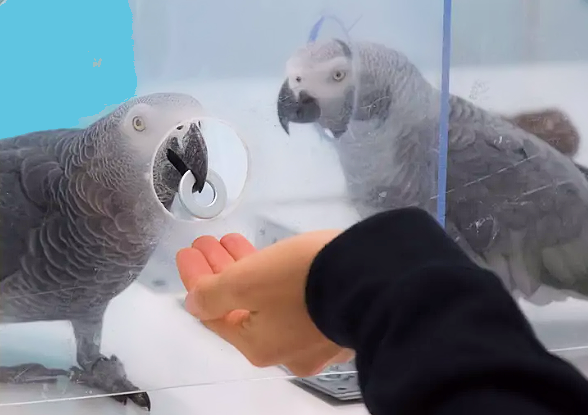
Interestingly, this behavior was not universal among birds. When the same experiment was conducted with blue-headed macaws, the results were entirely different. The macaws acted selfishly, keeping the tokens for themselves.
Understanding Prosocial Behavior
Prosocial behavior is a voluntary action or helping behavior intended to benefit others. These actions are motivated by empathy, compassion, and a genuine desire to improve the well-being of individuals, groups, or society. Unlike selfish or transactional behaviors (characterized by a “give-and-take” dynamic), prosocial actions are not driven by external rewards or obligations.
The African grey parrots in Brucks’ study exhibited true prosocial behavior, acting selflessly to help their companions.
Humanity’s Struggle with Selflessness
For fallen humanity, the tendency to prioritize self-interest is deeply ingrained. Because of our fallen nature, we instinctively look out for ourselves first. Being transactional and goal-oriented has become the norm. However, even in our brokenness, we can learn to balance these transactional actions with genuine care and empathy, enabling us to perform acts of generosity and kindness.
Nonetheless, the standard set by the Father for His children is much higher. As children of the King, we are called to reflect our Father’s character. He shows kindness, even to those who are ungrateful, malicious, and wicked.
Luke 6:31-35: “Do to others as you would like them to do to you. ‘If you love only those who love you, why should you get credit for that? Even sinners love those who love them! And if you do good only to those who do good to you, why should you get credit? Even sinners do that much! And if you lend money only to those who can repay you, why should you get credit? Even sinners will lend to other sinners for a full return.”
“‘Love your enemies! Do good to them. Lend to them without expecting to be repaid. Then your reward from heaven will be very great, and you will truly be acting as children of the Most High, for he is kind to those who are unthankful and wicked.’”
The Motivation Behind Kindness
While many of us engage in acts of kindness, it is crucial to reflect on our motivations. Are we being kind to impress others, to boost our self-esteem, or to make amends for past mistakes? True selflessness, as modeled by the Father, demands a higher motivation, one that is based on love and a desire to reflect His character.
REFLECT & PRAY
It is natural to put our own interests first. It is supernatural to put the interests of others first.
Father, what a high and lofty standard You have set. Only through Your supernatural enablement can I even begin to live up to it. Encourage and empower me to adopt an attitude and a way of life that consistently puts others first.
INSIGHT
The Importance of Motivation in Helping Others
Helping others and doing good are undoubtedly admirable actions. However, the motivation behind these actions often matters more than the actions themselves. As children of the King, we are called to reflect the same love and concern that the Father has for us. Our actions should be motivated by a selfless, Christ-like attitude, as commanded in Philippians 2:5: “You must have the same attitude that Christ Jesus had.”
A Call to Humility
True humility is a cornerstone of the Christian life. It requires us to shift our focus away from our own desires and struggles, inviting us instead to invest our hearts and minds in the well-being of others. In this selfless posture, we cultivate deep connections and foster a spirit of compassion, illuminating the path to a life rich in love and service.
As Andrew Murray aptly stated, “The humble person does not think mainly of himself; he simply does not think of himself at all.”
Philippians 2:3-4: “Don’t be selfish; don’t try to impress others. Be humble, thinking of others as better than yourselves. Don’t look out only for your own interests, but take an interest in others, too.”
Humility involves an honest and balanced understanding of ourselves, recognizing the grace that the Father has given us. It is neither self-deprecation nor self-exaltation but an accurate evaluation of who we are in Christ.
Romans 12:3: “Because of the privilege and authority God has given me, I give each of you this warning: Don’t think you are better than you really are. Be honest in your evaluation of yourselves, measuring yourselves by the faith God has given us.”
As Wiersbe explains, “The truly humble person knows himself and accepts himself (Romans 12:3). He yields himself to Christ to be a servant, to use what he is and has for the glory of God and the good of others.”
Genuine Concern for Others
While it is natural to prioritize our own interests, the Father calls us to a higher standard of genuine concern for others’ well-being. This level of selflessness is both rare and extraordinary, as noted in the ESV Study Bible Notes: “The key is to take that same level of concern and apply it also to the interests of others. Such radical love is rare.”
This standard is rooted in agape love, the pure, selfless love that seeks the good of others without expecting anything in return.
The Nature of Agape Love
Agape love is a divine love that goes beyond human feelings and reactions. It is marked by an unstoppable kindness that remains strong even in the face of hatred or ugliness. As Barclay describes, “Agape love is unconquered goodwill that never knows bitterness and never seeks anything but the good of others. It is not a mere reaction of the heart, as human love is; it is a victory of the will, achieved by the help of Jesus Christ.”
“It does not mean loving only those who love us, or those whom we like, or those who are lovable. It means an unconquerable goodwill even to those who hate us, to those whom we do not like, to those who are unlovely.”
This is the standard of love that the Father has established for the children of the King, a love that reflects His own.
The Generosity of Giving
Beyond the call to selflessness and love, Scripture assures us that generous, unselfish giving results in abundant blessings.
Luke 6:38: “Give, and you will receive. Your gift will return to you in full, pressed down, shaken together to make room for more, running over, and poured into your lap. The amount you give will determine the amount you get back.”
This principle of giving reflects the Father’s generosity and reminds us that selfless acts of love and kindness not only bless others but also enrich our own lives.
Conclusion
Prosocial behavior reflects the best qualities of human nature, demonstrating our capacity for empathy, generosity, and selflessness. It is a vital component of healthy relationships and thriving societies.
As children of the King, we are called to a life of humility, selflessness, and agape love. Our actions should mirror the love of Christ, driven not by personal gain but by a sincere desire to serve and uplift others. By doing so, we uphold the Father’s high standards and experience the joy and blessings that come from living a life of love and generosity.
¯\_(ツ)_/¯2-04-2
© Dr. H 2025
 Dr H Reflections