
Christmas Treasure from St. Petersburg
I tell you the truth, until heaven and earth disappear, not even the smallest detail of God’s law will disappear until its purpose is achieved. – Matthew 5:18
2 Timothy 3:16-17
16 All Scripture is inspired by God and profitable for teaching, for reproof, for correction, for training in righteousness;
17 so that the man of God may be adequate, equipped for every good work.
Codex Sinaiticus: A Priceless Treasure of Scripture
On December 24, 1933, an extraordinary artifact arrived in Great Britain from St. Petersburg, Russia: Codex Sinaiticus. This unmatched manuscript, often called the “Sinai Bible,” was sold by the Soviet Communist government to the British government for a staggering £100,000, about $129,138 at the time. When adjusted for inflation, that amount exceeds $3,000,000 in today’s money. Still, no amount of money can truly measure the importance of this priceless manuscript.
A Testament to Ancient Craftsmanship
Codex Sinaiticus is one of the most significant literary artifacts in human history. It was handwritten in the 4th century A.D. This manuscript contains the oldest known complete New Testament, along with large portions of the Septuagint, the Greek translation of the Old Testament.
Originally comprising about 1400 vellum pages, roughly half of the manuscript survives today. The text is written in UNCIAL script, all uppercase letters, with no spaces or punctuation, demonstrating the careful craftsmanship and dedication of its scribes.
The Discovery of the Codex
The discovery of this invaluable manuscript is credited to German Biblical scholar Constantin von Tischendorf. During a 1844 visit to the Monastery of Saint Catherine in the Sinai Peninsula, Tischendorf came across what would become one of the most important finds in Biblical scholarship.
Surprisingly, the Codex was nearly lost to history. Tischendorf found several parchment leaves discarded in a wastebasket, intended for burning by the monks. Recognizing their extraordinary value, he saved 129 of these leaves, which he identified as parts of the Septuagint.
Eventually, Tischendorf convinced the monastery to entrust the manuscript to Tsar Alexander II of Russia in exchange for assurances of protection for their monastery. This transfer safeguarded the Codex from further neglect, although it remained hidden from public view in Russia for over a century.
A Connection to Emperor Constantine
It is thought that Codex Sinaiticus might be one of the 50 Greek copies of the Bible commissioned by Roman Emperor Constantine after his conversion to Christianity. His conversion marked the beginning of Christianity’s rise to prominence within the Roman Empire.
The Codex remained hidden from the world for about 1450 years until Tischendorf’s efforts preserved it from destruction. Even after its discovery, it remained mostly inaccessible, kept in museums and academic institutions for another 150 years.
A New Era of Accessibility
In July 2009, Codex Sinaiticus was fully digitized and made available online, marking a historic milestone in Biblical scholarship. This critical development allowed scholars, theologians, and the global community to examine its pages in unprecedented detail. What was once nearly destroyed is now accessible to the world, continuing to shed light on the history of scripture and early Christianity.
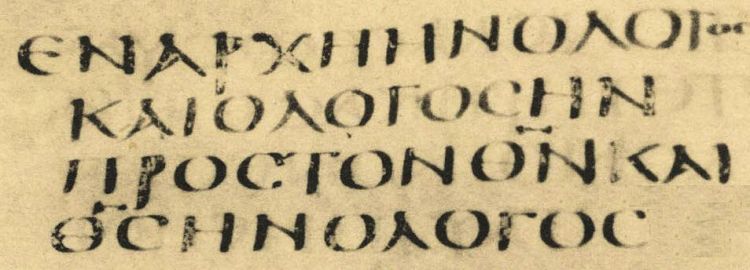
In beginning was the Word
and the Word was
with the God and
God was the Word.
John 1:1 from Codex Sinaiticus
REFLECT & PRAY
The Scriptures provide a reliable foundation, revealing all that the Father intends for His children to know in this life. They prepare and empower us to serve Him faithfully and live lives that bring Him joy.
Father, thank You for loving us enough to reveal Your truth to us through the precious treasure we now call the Word of God.
INSIGHT
The Priceless Gift of Scripture: God’s Word to Humanity
Consider the profound paradox and inherent sadness of individuals who, devoted to serving God as they understood Him, unknowingly destroy the very Word of God? Such was the case with Codex Sinaiticus, which was nearly lost because of a lack of recognition of its extraordinary significance and value. This priceless manuscript, a gift from the Father to the world, remained hidden until Christmas Eve, 1933, nearly two millennia after He sent forth His greatest treasure, His Son, the Lord Jesus Christ, into our midst.
Understanding the Bible’s True Worth
Do we truly grasp the treasure we hold in the Bible? Is it truly the Word of God? To answer this, we first need to settle two fundamental questions about the God in Whom we believe:
- Is God loving?
- Is God all-powerful?
If we affirm that the Father is both loving and all-powerful, two additional questions naturally arise:
- Would a loving God desire to reveal His truth to His creation, which He cherishes?
- Does He have the power to ensure this revelation reaches us?
Our confidence in the authenticity and reliability of the Scriptures relies on our answers. When we confidently answer both questions with “Yes,” we establish the foundation of our faith. Our trust in the Scriptures remains strong because it is not based on speculation but on the very character of God.
The Bible: God’s Direct Communication
The Bible unequivocally claims to be the Word of God, His direct communication to the people of planet Earth.
As 2 Timothy 3:16 declares, “All Scripture is God-breathed, useful for teaching, rebuking, correcting, and training in righteousness.”
This verse reminds us that the Scriptures are much more than just a collection of ancient writings. They are a life-giving testament to God’s truth, purposely created to guide, teach, and equip His children for every good work.
Hughes and Chapell assert that, put simply, the Bible says that it is the work of God; it is God’s product. The Father is responsible for its creation. The Greek word translated as “God-breathed” is theopneustos, meaning “breathed out by God.” This term describes the divine process through which the Scriptures were made. The Father “breathed into” the Scriptures, ensuring they are His product, created to reveal His eternal truths.
The Inerrancy and Authority of Scripture
The Bible’s claim to be “God-breathed” leaves no room for compromise. It is either entirely true or it is not. The Father, Who is Truth, would not mislead or deceive His children. His Word is accurate, precise, authoritative, and dependable.
Ryrie explains that the Father breathed out the Scriptures through human authors, using their personalities and experiences to communicate His eternal truths. The Father guided and protected them as they recorded His message, but did not dictate it. The Father is the source, the creative intelligence, and the driving force behind the Bible.
2 Timothy 3:16 affirms three foundational truths about the divine inspiration of Scripture:
- Every part of the Bible is included.
- All Scripture is breathed out by God.
- The Bible reflects the perfection of its Author, free from flaw or defect.
Ryrie clarifies that the term “inerrancy” is often used to describe the Bible’s truthfulness. While the word inerrancy is not found in Scripture, its meaning is clear: the Bible tells the truth. The Scriptures do not merely contain truth; they are Truth. When the original documents were written, they imparted God’s message without error.
The Role of the Holy Spirit
The Apostle Peter asserts in 2 Peter 1:21: “No prophecy in Scripture ever came from human initiative. Instead, people spoke on behalf of God as they were guided and carried along by the Holy Spirit.”
The Greek term translated as “carried along” is phero, which “conveys the idea of being moved or guided, much like a ship driven by wind and tides” (as described in Acts 27:17). This imagery illustrates how the Holy Spirit directed the human authors of Scripture.
The prophets did not fabricate or invent their messages. They served as conduits, delivering what the Holy Spirit compelled them to share. They conveyed it accurately. The prophets spoke as the Holy Spirit guided them. The human authors were active in writing while being directed by the Spirit. Their writings reflect their individual personalities, training, and journeys, yet the message remained divinely inspired and free from error.
The Bible: A Divine Testimony
The Chicago Statement on Biblical Inerrancy, written in 1978, affirms that the Scriptures are the Father’s Word, written by individuals who were prepared and superintended by His Spirit. Through the Bible, we encounter the living God and His eternal truth. It is accurate, trustworthy, and carries divine authority over every issue it covers.
The Bible is to be:
- Believed as the Father’s instruction in all that it affirms.
- Obeyed as the Father’s command in all that it requires.
- Embraced as the Father’s promise in all that it pledges.
The Father, Who embodies Truth, has revealed Himself through the Scriptures. This divine revelation is a priceless gift that provides guidance, hope, and assurance to everyone who seeks Him. Through His Word, the Father equips His children to live faithfully and serve Him with joy and confidence.
Codex Sinaiticus is more than an ancient manuscript; it is a testament to the lasting power of God’s Word. Its preservation and accessibility remind us of the Father’s faithfulness in making sure that His truth reaches every generation.
¯\_(ツ)_/¯
© Dr. H 2025
 Dr H Reflections