
Blind Justice?
He will judge the world with justice and rule the nations with fairness. – Psalms 9:8
Psalms 85:10: Lovingkindness and truth have met together; righteousness and peace have kissed each other.
Jeremiah 23:5: “For the time is coming,” says the Lord, “when I will raise up a righteous descendant from King David’s line. He will be a King who rules with wisdom. He will do what is just and right throughout the land.”
The Modern Image of Justice
In modern society, justice is commonly pictured as a blindfolded woman holding balanced scales in one hand and a sword in the other. This enduring image embodies the ideals of fairness, impartiality, and equality before the law. Each element carries symbolic weight. The scales suggest careful, measured evaluation of evidence; the upward-pointing sword represents the authority to render and enforce judgment; and the blindfold signifies that justice should remain uninfluenced by visible differences.
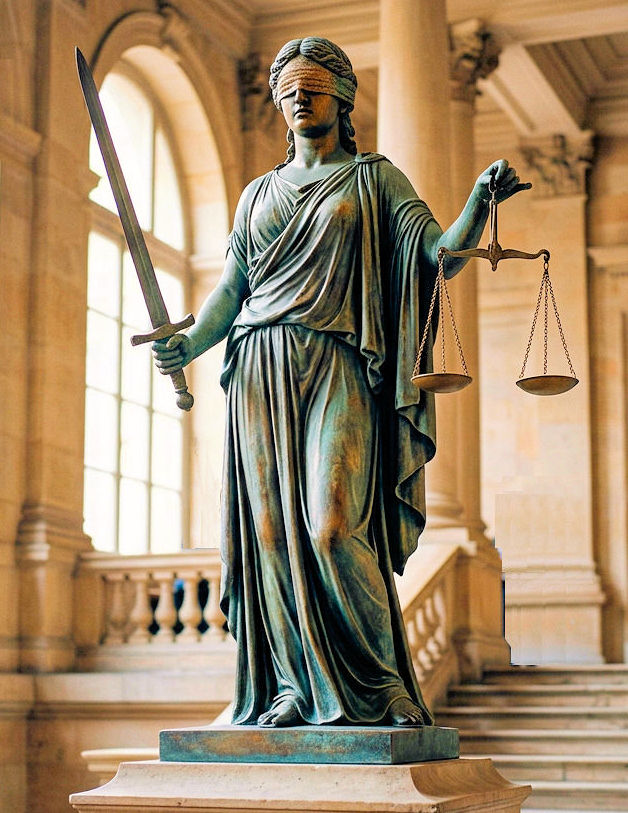
Lady Justice wears a blindfold to represent unbiased judgment. Justice must not be swayed by outward appearance. Instead, it remains blind to irrelevant human differences and concentrates only on what is fair and lawful. Factors such as nationality, ethnicity, religion, skin color, sex, wealth, or social standing should not affect legal judgment. The ideal is that every case is decided according to its facts, and every individual is treated with the same standard of fairness under the law.
Taken together, this symbol expresses a vision of justice that is objective rather than biased, principled rather than partial, and accountable to truth rather than personal or preferential status. It embodies the aspiration for a legal system where judgments are based on fairness and honesty, not bias or favoritism.
Tragically, history shows how difficult it has been for societies to live up to this ideal. Although justice is meant to be impartial, favoritism and influence have often distorted it. Too often, the law has been applied unevenly, protecting some while failing others. This reminds us that true justice requires more than symbolism or legal theory. It must rest on a moral foundation, a commitment to truth, and a firm refusal to let personal bias determine what is right.
When Power Becomes the Standard
For much of human history, justice has often been governed less by moral principle than by power. In such systems, the idea that “might makes right” becomes the operating reality. Those with wealth, influence, military strength, or political authority function as though they are above accountability. Instead of living under the law, they effectively define and control it.
Ancient Rome offers a clear example. Although Rome developed an impressive legal tradition and contributed significantly to Western concepts of law and governance, its system was far from impartial. Social rank played a major role in how justice was administered. Patricians, senators, magistrates, and other elites enjoyed privileges unavailable to ordinary citizens, while slaves, foreigners, and conquered peoples possessed far fewer protections. In many cases, legal outcomes were shaped not simply by truth or fairness, but by status, patronage, and political influence.
Roman law was highly developed, yet it functioned within a deeply unequal society. Rome shows that a civilization can possess an advanced legal system and still fall short of true justice. No legal order is truly just if it bends to position and power rather than to moral truth and impartial application.
Competing Visions of Social Justice
Traditionally, social justice was seen in practical and relational terms: feeding the hungry, caring for neighbors, protecting the vulnerable, and offering compassion and support to those in need. Ideally, this perspective highlighted mercy, personal responsibility, and active love within communities.
Recently, the discussion has broadened to focus on systems, institutions, public policies, and the social conditions that shape opportunities and outcomes. Many now see government action and institutional reforms as key tools for tackling injustice and fostering equality. However, this approach prompts important questions: what about personal liberty, private property, and moral responsibility? What about those with wealth, influence, or status? Too often, addressing one form of inequality simply replaces it with another.
While these efforts often stem from genuine concern for the common good, history shows that political solutions alone can’t build a just society. True justice also rests on moral conviction, wise governance, vibrant faith communities, and a shared commitment to human dignity and responsibility.
REFLECT AND PRAY
These words have been attributed to Jane Addams, though they are more widely associated with Martin Luther King Jr. “True peace is not merely the absence of war but the presence of justice.”
Father, thank You for being just and righteous. You show partiality to no one. Your unchanging truth in the Word of God provides a firm foundation for life, law, governance, fairness, and justice.
INSIGHT
Justice and the Need for Moral Absolutes
Outside the Scriptures, legal systems based on universal accountability have been quite rare. The Ten Commandments and the Torah stand out because they establish moral standards founded on God’s authority rather than the will of human rulers. In many ancient civilizations, such as Egypt, Assyria, and China, laws were mainly based on the decrees of kings, emperors, or ruling elites. Hammurabi’s code was a significant early effort to formalize law, and Greece and Rome also developed influential legal traditions. However, these systems did not always deliver justice equally or consistently.
In contrast, many modern approaches, particularly those influenced by ideological concerns about social inequality, tend to interpret human issues mainly through the lens of structural injustice, poverty, and unequal resource distribution. Francis Schaeffer noted that this view often considers “unjust social structures,” especially “the maldistribution of wealth,” as the primary cause of evil in the world.
A theistic worldview starts from the belief that God exists as the Creator of all things, and that humans are accountable to Him. Without God, there are no ultimate moral standards, making notions of right and wrong malleable and reducing justice to mere preference, power, or politics.
God has revealed a different foundation for society through His Word, providing steady standards of good and evil. Societies that base their morals on scriptural absolutes have legal and ethical systems that transcend individual desires and political interests. This idea is reflected in the phrase “One Nation under God,” added to the Pledge of Allegiance in 1954.
Justice is Not Blind but Impartial
Biblical justice is grounded not in blindness, but in truth. Because God has established absolute moral standards, justice can be impartial without becoming arbitrary. Each person can be judged fairly because each person stands under the same divine standard.
In this sense, justice is not blind in a literal sense; rather, it is impartial. It does not disregard truth but applies it without favoritism. Judges are called to decide cases objectively, according to law rather than personal preference, and all who testify are bound to speak truthfully before God. The familiar commitment to tell “the truth, the whole truth, and nothing but the truth” reflects this principle well. Justice, therefore, is not rooted in shifting human opinion, but in a moral standard that stands above every individual.
The Reformation and the Recovery of Justice
This understanding of justice, marked by impartiality yet firmly grounded in absolute truth, did not become deeply influential in the modern West until the Reformation of sixteenth-century northern Europe. By placing the Scriptures at the center of moral reasoning and legal thought, the Reformation helped shape a social order in which liberty could coexist with accountability. Law no longer rested on the whims of rulers, but on transcendent standards that stood above human authority. In this way, the Reformation contributed to societies in which liberty and accountability could be maintained in balance; freedom could exist without collapsing into disorder or arbitrary rule.
Justice Lifts the Nations
A striking visual expression of this principle appeared centuries later in Paul Robert’s 1905 mural Justice Lifts the Nations, painted in the stairwell of the old Supreme Court Building in Lausanne, Switzerland. Positioned where judges would regularly pass on their way to the courtroom, the mural functioned as more than decoration. It served as a deliberate moral reminder that justice must be grounded in divine truth rather than shaped by public opinion, political pressure, or personal ambition.

Robert’s depiction of Justice is especially significant. Unlike the familiar modern image of blindfolded justice, his figure sees clearly. This artistic choice suggests that justice is not meant to ignore reality, but to perceive clearly and judge rightly. She holds the traditional scales, symbolizing careful evaluation and impartial judgment, along with a sword that represents the authority to enforce what is right. Yet the sword is not lifted upward in abstraction or self-assertion. Instead, it points downward toward a book inscribed with the words “The Law of God.” That detail is central to the mural’s meaning: justice does not originate in human power or social consensus but is directed by a higher moral law.
The foreground adds another layer of meaning. There, Robert includes a range of legal scenes that reflect the varied and often difficult cases judges must weigh. These scenes suggest that justice is not merely an ideal discussed in theory, but a principle that must be applied in the concrete realities of human conflict, responsibility, and judgment. Taken as a whole, the mural presents a clear and compelling message: justice and freedom endure only when founded on the law of God.
Biblical Justice: Impartial, Truthful, and Accountable
The world often imagines justice as blind, suggesting that fairness requires suspending all distinctions and refusing to see anything particular about the people or circumstances involved. Biblical justice presents a different vision. It is not blind in the sense of ignoring reality, but impartial in the sense of refusing favoritism. It does not deny human differences, evade moral truth, or pretend that all claims are equally valid. Instead, it calls for clear judgment governed by truth and accountability before God.
In the biblical view, justice is never a matter of personal preference, political advantage, or social pressure. It does not bend to wealth, status, influence, or emotional manipulation. Rather, it measures every person, every action, and every accusation by the same unchanging standard. Because God is perfectly righteous, His justice is constant and dependable, not arbitrary or unreliable. It flows from His character and is revealed in His law.
Justice Grounded in God’s Truth
This understanding gives justice both firmness and balance. Where God’s truth governs, justice can be fair without becoming arbitrary, strong without becoming oppressive, and principled without losing compassion. It protects the innocent, restrains wrongdoing, and upholds moral order without surrendering to partiality or impulse. In this way, biblical justice joins moral clarity with righteousness, refusing both cruelty and compromise.
Such justice requires more than procedure. Justice requires moral vision. A judge must see clearly, weigh carefully, and decide faithfully. The goal is to render judgment in a way that reflects what is true and right. For that reason, justice must see facts clearly, distinguish right from wrong, and remain anchored in a standard higher than human opinion.
A Higher Standard
Biblical justice is based on the belief that God has established a righteous law higher than any individual or human institution. No ruler, court, or society has the right to alter justice based on shifting desires or cultural trends. When law is disconnected from truth, justice becomes unstable and susceptible to manipulation by those with power. Conversely, when rooted in God’s righteous law, justice can maintain order and uphold human dignity.
Biblical justice is best understood not as blind neutrality, but as clear-sighted impartiality. It refuses favoritism, rejects corruption, and submits itself to truth. Its strength lies not in pretending not to see, but in seeing rightly under God’s authority.
¯\_(ツ)_/¯
© Dr. H 2026

