
Starry Night
When I look at the night sky and see the work of your fingers – the moon and the stars you set in place – Psalms 8:3
Psalms 19:1-4
The heavens proclaim the glory of God. The skies display his craftsmanship.
Day after day, they continue to speak; night after night, they make him known.
They speak without a sound or word; their voice is never heard.
Yet their message has gone throughout the earth, and their words to all the world. God has made a home in the heavens for the sun.
Romans 1:20 For ever since the world was created, people have seen the earth and sky. Through everything God made, they can clearly see his invisible qualities – his eternal power and divine nature. So, they have no excuse for not knowing God.
Artistic Intuition, Natural Order, and the Question of Design
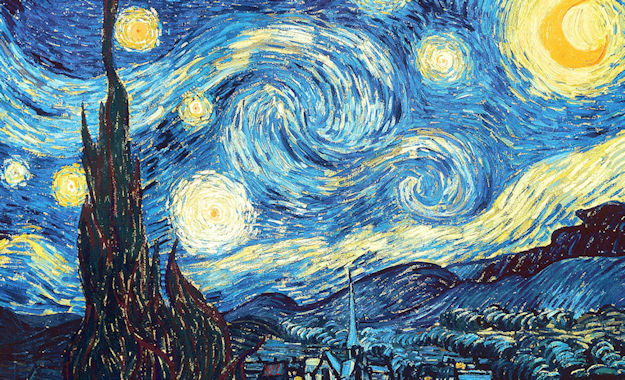
Vincent van Gogh’s The Starry Night, painted in June 1889, offers a powerful image of the night sky. The painting features swirling blue shapes, a bright yellow moon, and glowing stars surrounded by rings of light. The sky appears full of energy and motion, making the scene feel both imaginative and alive.
Van Gogh used curved lines and layered brushstrokes to create the effect of movement. Instead of looking calm or still, the sky seems to flow and swirl. This feature caught the attention of researchers in marine science and fluid dynamics, who studied the painting to see whether its patterns resembled real movement in nature. They found that Van Gogh’s depiction of turbulence closely matches scientific ideas about how air and fluids move.
Researchers suggest that van Gogh may have developed this effect through close observation of clouds, wind, and shifting light, or through a strong intuitive sense of motion. In either case, the painting seems to convey more than mere spontaneity. It reflects an artist who paid close attention to the patterns and rhythms of the natural world. For this reason, some believe The Starry Night reveals a deep, intuitive understanding of nature.
Van Gogh once wrote, “For my part, I know nothing with any certainty, but the sight of the stars makes me want to dream.” His words reflect the emotional power of the night sky. The stars inspire wonder and imagination, while also pointing to something larger, more ordered, and greater than ourselves.
Creativity, Pattern, and the Limits of Chance
The significance of The Starry Night lies not only in its beauty but also in the deeper question it raises about order and meaning. Van Gogh’s sky may appear spontaneous at first, but its structure suggests more than randomness. Although the painting is highly expressive, it is not chaotic. Beneath its dramatic movement is a clear sense of pattern and order.
This invites a broader philosophical reflection on the connection between beauty, complexity, and intelligence. People often recognize that when something shows harmony, structure, and purpose, it usually points to intention rather than chance. In fields such as art, architecture, music, and engineering, intricate order is generally seen as the result of thought and design, not mere accident.
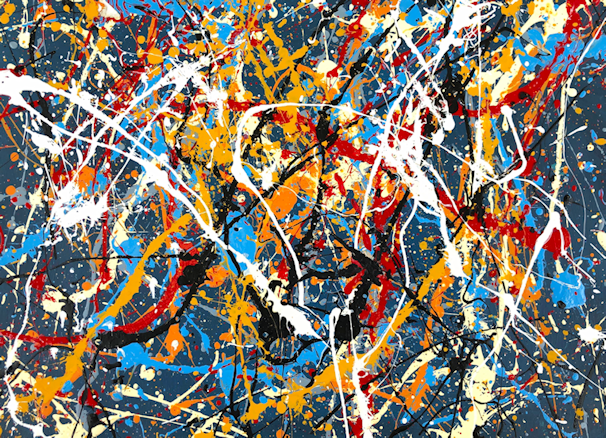
Could it be that van Gogh’s The Starry Night is simply the outcome of creative chance and spontaneous brushwork, similar to the style of Jackson Pollock?
William Paley and the Watchmaker Analogy
William Paley explained this idea clearly in Natural Theology in 1802. He asked readers to imagine finding a watch on the ground. Unlike a stone, a watch would not seem accidental. Its gears, springs, and moving parts are carefully arranged to serve a purpose. Because of its complexity and function, it makes sense to conclude that it was made by an intelligent designer.
Paley extended this analogy to the universe, arguing that if a watch implies a watchmaker, the intricate order and complexity of the natural world indicate an intelligent creator. Intelligent design is the idea that specific features of the universe and living organisms are best explained by an intelligent cause rather than by undirected processes such as random chance or natural selection.
REFLECT & PRAY
Newell recalls that “Napoleon, on a warship in the Mediterranean on a star-lit night, passed a group of his officers who were mocking at the idea of a God. He stopped and, sweeping his hand toward the stars, said, ‘Gentlemen, you must get rid of those first!’”
Father, thank You for revealing Yourself through nature, sparking curiosity and guiding people toward You. Thank You for providing Special Revelation through Your Word, which offers explicit, detailed insights into our fallen DNA and our need for a Savior. Thank You for the Lord Jesus Christ, who came into the world to save us from our sins.
INSIGHT
Natural Revelation and the Witness of Creation
The observation of nature and the created order have long been described as natural revelation. Natural revelation refers to the knowledge of God that can be perceived through the physical universe, the order of creation, and the moral structure woven into human experience. It is the understanding that certain truths about the Creator may be recognized by examining the world He has made, even apart from direct supernatural disclosure.
Through creation, people can perceive that the universe is neither self-explanatory nor ultimately meaningless. The beauty, order, complexity, and consistency of the natural world point beyond themselves to a Creator whose existence and attributes are reflected in what He has made. Natural revelation does not provide a complete theology, but it does offer genuine and substantial testimony to the reality of God.
The apostle Paul explains in Romans 1:20: “For ever since the world was created, people have seen the earth and sky. Through everything God made, they can clearly see his invisible qualities, his eternal power, and divine nature. So they have no excuse for not knowing God.”
Romans 1:20 teaches that creation reveals real truth about God. By observing the world, people can see evidence of His power and divine nature. The created order displays intelligence, majesty, and design, making the reality of God evident through visible things.
The Characteristics and Limits of Natural Revelation
Natural revelation has several key traits. It is universal, as everyone can observe evidence of God in creation. It is understandable, reason and observation allow people to recognize truths about the Creator. It is continuous, with each generation witnessing the same created order that proclaims God’s glory. Yet, it is also limited in scope. It provides “true truth,” but not “exhaustive truth.” It reveals God’s existence, power, and majesty, but does not fully disclose His grace, redemptive plan, or the way of salvation.
Therefore, while natural revelation is important, it is not sufficient by itself. It points people toward God, awakens spiritual awareness, and suggests humanity is accountable, but it does not convey the full message of reconciliation and salvation.
Special Revelation and the Knowledge of Salvation
While natural revelation points to the reality of God, special revelation makes His character, will, and saving purpose known more clearly. Special revelation is the truth God has revealed directly, through the Scriptures. In the Bible, God reveals not only that He exists but also Who He is, how He relates to humanity, and how people may be reconciled to Him.
Through special revelation, we learn of God’s love, holiness, mercy, and grace. We also see His covenant faithfulness, His moral will, and His plan of redemption through the Lord Jesus Christ. What nature alone cannot reveal, Scripture makes known. It shows humanity’s fallen condition, the need for a Savior, and the way to eternal life.
The Heavens Declare the Glory of God
Psalms 19:1-4:
“The heavens proclaim the glory of God. The skies display his craftsmanship. Day after day they continue to speak; night after night they make him known. They speak without a sound or word; their voice is never heard. Yet their message has gone throughout the earth, and their words to all the world.”
This passage eloquently expresses creation’s ongoing testimony. The heavens proclaim God’s wonder and glory not through words but through their beauty, order, and grandeur. Day after day and night after night, creation provides a silent witness to its Creator. The skies show deliberate craftsmanship rather than randomness, and order rather than chaos. Their message extends across the entire Earth, communicating to every generation.
At the same time, the psalm shows both the strength and the limits of this witness. Creation truly reveals God’s existence and majesty, but it does not communicate the full message of redemption. The witness of creation is powerful, but it must be joined by the witness of the Scriptures to bring a person to a saving knowledge of God.
From Awareness to Relationship
The distinction between natural and special revelation is essential. Natural revelation shows that God exists, while special revelation reveals Who He is in His covenant love and redemptive mercy. Natural revelation awakens awareness of God, but special revelation brings deeper understanding. The first points to His power and majesty; the second makes known His grace, truth, and salvation through the Lord Jesus Christ.
This movement from awareness to relationship is captured beautifully in the hymn by Ralph Carmichael. The opening lines acknowledge the testimony of creation:
“In the stars His handiwork I see
On the wind He speaks with majesty
Tho’ He ruleth over land and sea
What is that to me”
These lines express the truth of natural revelation. The stars and the wind testify to divine majesty, power, and sovereignty. Yet the hymn does not end there. It moves beyond distant awareness to a personal encounter:
“‘Til by faith I met Him face to face
And I felt the wonder of His grace
Then I knew that He was more
Than just a God who didn’t care
That lived away out there”
Here the focus shifts from creation’s testimony to the personal knowledge of God made possible through faith. The God who is seen in the heavens is no longer perceived as distant or impersonal. He is known in grace, nearness, and loving care. This is the realm of special revelation, where the Creator is not only recognized but personally known.
The hymn concludes with the comfort of ongoing fellowship:
“And now He walks beside me day by day
Ever watching o’er me lest I stray
Helping me to find that narrow way
He’s ev’rything to me”
These words express the richness of a life shaped not merely by awareness of God’s existence but by a relationship with Him. Creation may awaken the soul to wonder, but the Scriptures reveal the path to communion, redemption, and a faithful daily walk.
The Necessity of Both Forms of Revelation
Natural and special revelation are not rivals. They can work together as complements. Creation testifies to God’s glory, power, and divine nature, leaving humanity without excuse. The Scriptures then unveil His saving will, redemptive love, and provision through Christ, offering hope of salvation. Together, they provide a comprehensive picture of God’s self-disclosure—creation displays His greatness, while the Word reveals His grace. The heavens showcase His craftsmanship, and Scripture exposes His heart. Through both, the Father invites humanity not only to recognize His existence but also to know, trust, and walk in His way of life.illi
¯\_(ツ)_/¯9-29-4
© Dr. H 2026

