
Wiley and the Unstoppable Pig
Be still, and know that I am God! – Psalms 46:10
Philippians 4:6-7
Don’t worry about anything; instead, pray about everything. Tell God what you need, and thank him for all he has done. Then you will experience God’s peace, which exceeds anything we can understand. His peace will guard your hearts and minds as you live in Christ Jesus.
The Unstoppable Pig
The feral hog is one of the most destructive animals in North America. It uproots crops, contaminates water sources, and devastates ecosystems with a persistence that borders on the relentless. For decades, wildlife managers, farmers, and government agencies have tried nearly everything to bring the population under control: trapping, hunting, aerial gunning, and chemical deterrents.
The hogs did not succumb to management efforts; instead, they absorbed them. The more pressure the agencies exerted, the more the animal adapted. The problem outpaced the capacity of human systems to contain it. Yet tucked inside this ecological crisis is a profound spiritual truth: some problems are too large for human hands alone.
The History of the Hog Problem
The feral hog, Sus scrofa, is not native to North America. Spanish explorers introduced domesticated pigs to the continent in the 1500s, and over the centuries, escaped animals bred with Eurasian wild boars, producing an extraordinarily adaptable creature. Today, an estimated 6 to 9 million feral hogs roam across at least 35 states, according to the USDA, causing roughly $2.5 billion in agricultural damage annually.
Eradicating feral hogs is challenging because their resilience stems from the very traits that enable them to survive and multiply so effectively. Their rapid reproduction allows populations to grow at a pace that often surpasses control efforts, while their high intelligence makes them formidable opponents. Feral hogs adapt easily to diverse environments, remain largely nocturnal, learn to recognize trapping patterns, and adjust their behavior when hunted.
In 2004, a photograph of an enormous wild hog suspended from a backhoe captured national attention after going viral. Shot and killed by Chris Griffin in Alapaha, Georgia, on June 17, 2004. It was originally widely considered a hoax or urban legend. Locals nicknamed the animal “Hogzilla,” a name that quickly became part of popular folklore. National Geographic later sent a team of experts to examine the case, and they estimated that the hog measured about 8 feet in length and weighed about 800 pounds. Its tusks reportedly measured 16 and 18 inches, adding to the animal’s extraordinary and intimidating reputation.
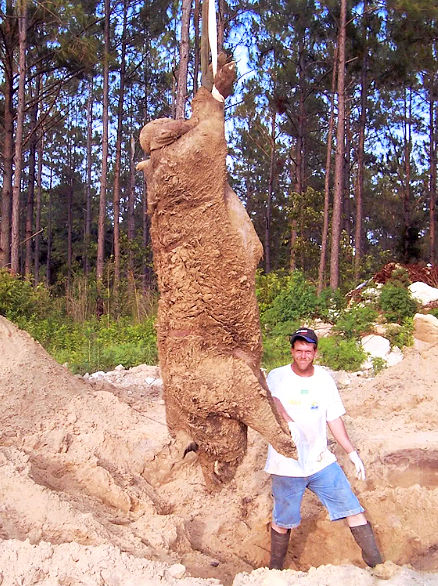
State agencies have poured resources into control programs for generations. Population models suggest that managers must remove approximately 70 percent of a regional hog population each year simply to prevent growth. That threshold has proven nearly impossible to meet through human effort alone.
Enter the Coyote
In recent years, researchers have identified an unexpected pattern in regions with healthy, stable coyote populations: feral hog numbers tend to be lower. The decline is not dramatic, but it is measurable. Long regarded as little more than a nuisance, coyotes appear to exert meaningful pressure by preying on piglets, disrupting nesting, and slowing reproduction in ways that human control efforts have often failed to achieve.
Coyotes are highly adaptable predators that exploit available food sources. The feral hogs provide a delicious, readily available, abundant source of fresh meat on the hoof. They would generally target strays, piglets, and smaller juveniles. Occasionally, coyotes have been observed hunting in groups and confronting larger hogs. Their hunting method is their normal foraging behavior. It is not a highly coordinated campaign against hog populations.
For that reason, claims that coyotes systematically conduct organized nighttime hunts against feral hogs should be treated cautiously. Popular stories, online videos, and AI-generated narrations often exaggerate the scale and coordination of this behavior. Even so, the broader point remains valid: coyotes do help control feral hog populations, even if their role is sometimes overstated.
What makes this especially remarkable is that the coyotes, often nicknamed “Wiley” because of their perceived cunning, are accomplishing this without human direction, funding, or supervision. Their role is not the result of an organized management program but of an intelligently ordered ecosystem functioning as it was designed to. In this case, the natural world has quietly achieved what extensive wildlife management efforts have often struggled to accomplish.
The solution wasn’t achieved through new technology or advanced trapping techniques, but rather through the reemergence of a natural predator-prey relationship that existed in creation long before the problem arose.
Spiritual Lessons from the Feral Hog Dilemma
At its heart, the story of Wiley and the hog illustrates that some problems exceed human capacity. The Scriptures consistently call children of the King to acknowledge the limits of their own understanding and to trust in God’s wisdom and provision, particularly when circumstances seem intractable.
Solomon explains in Proverbs 3:5-6 that we are to,
“Trust in the Lord with all your heart; do not depend on your own understanding. Seek his will in all you do, and he will show you which path to take.”
The distinction here is not between faith and effort, but between relying on oneself and relying on God. Human understanding and ability have their limits, whereas divine wisdom and power are limitless.
REFLECT & PRAY
The Scriptures urge believers to recognize their own limits and to rely on God’s wisdom and provision, especially when situations appear unmanageable.
Father, thank You for leading me to face insurmountable problems that teach me to trust and depend upon You, not myself.
INSIGHT
Be Still and See the Salvation of the Lord
When the Israelites stood at the edge of the Red Sea, with Pharaoh’s army behind them and the waters before them, Moses delivered one of the most striking commands in the biblical narrative.
Exodus 14:13-14:
“Don’t be afraid. Just stand still and watch the Lord rescue you today. The Egyptians you see today will never be seen again. The Lord himself will fight for you. Just stay calm.”
The instruction was to remain still, not to devise a new strategy, escalate, or invent a solution. In that moment, Israel’s salvation would come through God’s intervention, not human ingenuity.
However, stillness does not imply passivity. Exercising faith does not mean doing nothing. Moses led the people forward, the priests stepped into the Jordan before the waters parted, and David ran toward Goliath. Scripture shows that faith doesn’t eliminate action but rather aligns it with the truth. Biblical faith involves taking action confidently, trusting that the outcome depends on God rather than solely on human effort.
Peace in the Midst of Insurmountable Circumstances
The Apostle Paul conveyed this truth from a situation that appeared insurmountable by all human standards. Writing from a Roman prison, he was not speaking from comfort or certainty, but from ongoing hardship. Despite this, he testified to a peace rooted not in circumstances changing, but in unwavering trust in God.
Paul comforts the Philippians in Philippians 4:6-7:
“Don’t worry about anything; instead, pray about everything. Tell God what you need, and thank him for all he has done. Then you will experience God’s peace, which exceeds anything we can understand. His peace will guard your hearts and minds as you live in Christ Jesus.”
Paul’s peace did not come from having his problems solved. His imprisonment remained real, and his situation was unchanged. What shifted was his perspective: instead of being controlled by his circumstances, he placed his trust in the One who governs all. This shows that God’s peace isn’t rooted in the absence of difficulties but in trusting God’s sovereign care during them.
The Central Lesson
Overall, these passages suggest that the biggest human challenges cannot be solved simply through increased force, better strategies, or relentless effort. Instead, they are initially addressed through faith in God, whose wisdom surpasses human understanding and whose power is not limited by what seems impossible. The Scriptures acknowledge the existence of seemingly insurmountable problems; they highlight that such issues expose the limits of human control and emphasize the need for divine assistance.
Facing Your Unstoppable Pig
Every person eventually faces some version of the feral hog: a problem that resists every strategy, drains every effort, yet persists, sometimes even grows, despite sincere attempts to bring it under control. It may take the form of a fractured relationship that seems beyond repair, a habit that outlasts every resolution, a fear that reason cannot quell, or a season of life that no careful plan has successfully navigated.
The Limits of Human Effort
The ecological lesson from Wiley is not that human effort has no value. The coyote’s survival still relies on habitat, policies, and protection. As of now, in many parts of the country, it is open season on coyotes. The more profound message is that certain issues are solved through a wisdom inherently embedded in the intelligent design of the created order.
Stillness as Redirected Trust
Psalms 46:10: “Be still and know that I am God!”
The stillness described here does not imply passivity or resignation. Rather, it calls for a deliberate reorientation of trust. It invites us to recognize that the Creator of all things possesses the wisdom and power to address what human effort alone cannot ultimately resolve. Such stillness is not the abandonment of responsibility, but the surrender of anxious self-reliance. Biblical stillness is not inactivity; it is a calm, steady, and deeply rooted confidence in the sovereignty of God. It is the posture of a heart that ceases striving for ultimate control and rests instead in the One whose authority, wisdom, and purposes remain unshaken.
Where Strategy Ends, and Faith Begins
The hog is real, and the challenge is real. Yet the God who wove solutions into the fabric of the natural world is the same God who meets human beings at the edge of their own limits. He is present where strategy runs out, where control fails, and where faith shifts from relying on human ability to trusting divine sufficiency. In those moments of fatigue and doubt, believers are not forsaken. Instead, these moments become the very places where God’s presence, wisdom, and power are felt most profoundly.
Solomon sagaciously writes in Psalms 127:1: “Unless the Lord builds a house, the work of the builders is wasted. Unless the Lord protects a city, guarding it with sentries will do no good.”
Human effort is essential, but it is not sufficient on its own. Builders must still build, and watchmen must still keep watch; yet in the end, both remain dependent on God. Lasting stability and true security in any work do not rest on human labor alone, but on the presence, will, and blessing of God. He alone grants what endures: genuine fruitfulness, lasting stability, and enduring security.
¯\_(ツ)_/¯
© Dr. H 2026

