
The Bug in the Human Design
Everything God created is good. – 1 Timothy 4:4
Genesis 1:27, 31
So God created human beings in his own image. In the image of God, he created them; male and female, he created them.
Then God looked over all he had made, and he saw that it was very good!
The First Bug and the Problem of Sin
On September 9, 1947, a team of engineers and computer scientists at Harvard University encountered a persistent malfunction in the Mark II computer. The machine was producing faulty results. It was frustrating because no one could immediately determine why. When the team finally examined the machine more closely, they discovered an actual bug: a moth caught between the relay contacts, disrupting the computer’s operation. At 3:45 p.m., Grace Murray Hopper recorded the incident in the logbook and attached the moth with the now-famous note, “First actual case of bug being found.”
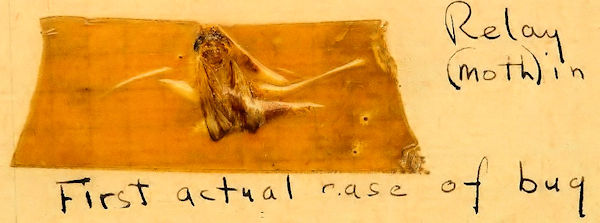
Although this incident became legendary in computing history, the term “bug” did not originate there. As early as the 1800s, people used it to describe defects, glitches, and mechanical malfunctions in various devices and systems. Thomas Edison helped popularize the term. He often used “bug” to refer to faults or issues he encountered in his innovative inventions, bringing the term into common use.
In information technology, a bug is an error or flaw in software or hardware that causes a system to behave in unintended or unpredictable ways. In simple terms, a bug is a flaw that causes a system to operate differently than intended. Programmers must therefore “debug” their work to ensure the system functions as intended.
Most bugs arise from human error.
This idea offers a powerful analogy for understanding the human condition.
Creation Without Defect
Adam and Eve were created pure, innocent, holy, and righteous. The original design had no flaw. As the Father surveyed the results of His creation, He repeatedly declared it good.
Genesis 1:31: “Then God looked over all he had made, and he saw that it was very good!”
This statement is more than a casual remark; it is a thorough assessment of creation in its finished form. The Father makes no errors. All that He made was good, and upon completing His work, He called it very good. Humanity, in its original form, was unblemished, uncorrupted, and morally sound.
If creation began in perfection, what changed? Was something added to human nature? Absolutely not! Nothing was added; wholeness and completeness were broken. Perfection was fractured; innocence was tainted.
Illustration of Light and Darkness -The Loss that Changed Everything
This truth can be illustrated by the relationship between light and darkness. God did not create darkness as an independent entity; He created light, and darkness simply exists where light is absent. Light has mass; darkness is formless and void
In the same way, the Father did not create sin as a separate substance or reality in itself. Sin is the loss of the unblemished goodness that humanity was created to possess, including innocence, purity, holiness, and a personal connection with Him. In this way, sin resembles darkness, not an entity of its own but the absence of light.
Sin is not merely the loss of good; it also involves the human heart’s deliberate revolt against God. When Adam and Eve ate from the tree of the knowledge of good and evil, they not only forfeited what was pure and holy but also consciously rebelled and disobeyed the Father’s command. At that moment, the loss affected humanity, similar to the “bug” that disrupted the Mark II computer and caused it to malfunction. Tragically, humanity has been malfunctioning ever since.
It wasn’t a moth trapped in a machine. Instead, darkness and rebellion became part of human nature. From then on, humans ceased functioning as originally designed. Corruption spread through all facets of life, spiritual, moral, and relational. What was once whole became broken. What was once pure became tainted.
REFLECT & PRAY
Consider the vastness and complexity of the universe, while also appreciating the precision and delicacy of the Father’s handiwork. Marvel at the beauty of the night sky, and contemplate the wisdom, intelligent design, and care with which it was formed.
Father, thank You for restoring what sin has damaged and for welcoming me into Your Forever Family. Continue Your work within me, correcting what is broken and shaping me according to Your design.
INSIGHT
The Goodness of Creation
Everything the Father created was inherently good. Each stage of creation was affirmed as good, and when His work was complete, He declared it very good. There were no defects or flaws.
Genesis 1:31: “Then God looked over all he had made, and he saw that it was very good!”
But what does goodness mean? The Hebrew word translated “good” is tov. In the Old Testament, and especially in Genesis, tov carries a broad and rich meaning. “It can describe what is beneficial, beautiful, pleasing, morally right, desirable, life-giving, or of great value.” It “reflects excellence.”
In Genesis, “good” refers to “everything that sustains, enriches, and supports life.” Creation is good because it comes from the Father, who is Himself good, and His goodness is reflected throughout His works. The world as He made it displayed beauty, order, harmony, and purpose.
For the infinite, all-powerful, all-knowing, eternal God, creation was not a burdensome effort. It was an expression of His authority, wisdom, and craftsmanship.
Psalms 19:1: “The heavens declare the glory of God, and the sky above proclaims his handiwork.”
Job 40:15-19:
“Take a look at Behemoth, which I made just as I made you. It eats grass like an ox. See its powerful loins and the muscles of its belly. Its tail is as strong as a cedar. The sinews of its thighs are knit tightly together.
Its bones are tubes of bronze. Its limbs are bars of iron. It is a prime example of God’s handiwork, and only its Creator can threaten it.”
The Scriptures portray creation not only as powerful, but also as exquisitely crafted. The Father’s work is described with both majesty and delicacy.
Psalms 8:3: “When I look at the night sky and see the work of your fingers – the moon and the stars you set in place.”
This image is particularly striking. It describes the heavens as the work of His fingers, suggesting precision, artistry, and effortless strength. What appears immeasurable and overwhelming to us was, for Him, an act of flawless craftsmanship. His creation shows not just power, but also tenderness and care.
He spoke, and what He willed came into being.
Psalms 33:9 For He spoke, and it was done; He commanded, and it stood fast.
The Need for Redemption
Once the bug of sin impacted humanity, everyone required spiritual renewal. Sin required a decisive and resolute response. The redemption of the human heart, mind, and spirit could not be accomplished through mere human effort or good intentions. The solution was simple in principle, yet the price was immeasurable. It could be realized only through the sacrificial work of the Lord Jesus Christ. His act of selflessness provided a pathway to reconciliation and healing, offering hope to all who would believe.
John 3:16: “For God so loved the world, that he gave his only Son, that whoever believes in him should not perish but have eternal life.”
The cost of this restoration was not measured in earthly currency. It required nothing less than the life of the Lord Jesus Christ. Through His sacrificial death, He accomplished what fallen humanity could never accomplish for itself: cleansing from sin, forgiveness before God, and the renewing of the human soul.
Whoever receives His sacrifice by faith is restored, forgiven, and brought into the Father’s Forever Family. In God’s sight, that person is made new.
John 1:12-13:
“But to all who believed him and accepted him, he gave the right to become children of God. They are reborn – not with a physical birth resulting from human passion or plan, but a birth that comes from God.”
This is the wonder of redemption: those who were broken by sin are brought back into relationship with the Father through the Son. What was corrupted is cleansed. What was lost is restored. Grace makes new what was spiritually broken.
Frederick William Pitt captures the pathos: “He died upon a cross of wood yet made the hill on which it stood.”
The Maker of the Universe
Poem by Frederick William Pitt (1859-1943)
The maker of the universe, as man for man, was made a curse:
The claims of laws which He had made, unto the uttermost He paid.
His holy fingers made the bough which grew the thorns that crowned His brow:
The nails that pierced His feet were mined in secret places He designed.
He made the forests where there sprung, the tree on which His body hung:
He died upon a cross of wood, yet made the hill on which it stood.
The sky that darkened o’er His head, by Him above the earth was spread:
The sun that hid from Him his face, by His decree was poised in space.
The spear revealing precious blood was tempered in the fires of God:
The grave in which His form was laid, was hewn in rock which He had made.
The throne on which He now appears was His from everlasting years:
But a new glory crowns His brow, and every knee to Him must bow.
¯\_(ツ)_/¯
© Dr. H 2026
 Dr H Reflections