
Out Damned Spot ∙
“Come now, and let us reason together,” Says the LORD, “Though your sins are as scarlet, they will be as white as snow; though they are red like crimson, they will be like wool.” – Isaiah 1:18
Isaiah 1:15-18
When you lift up your hands in prayer, I will not look. Though you offer many prayers, I will not listen, for your hands are covered with the blood of innocent victims.
Wash yourselves and be clean! Get your sins out of my sight. Give up your evil ways. Learn to do good. Seek justice. Help the oppressed. Defend the cause of orphans. Fight for the rights of widows.
“Come now, let’s settle this,” says the LORD. “Though your sins are like scarlet, I will make them as white as snow. Though they are red like crimson, I will make them as white as wool.
Scarlet Stains and Cleansing Grace
In July 2024, the Israel Antiquities Authority announced the discovery of an exceptionally rare woolen textile fragment, approximately 3,800 years old, in the Cave of Skulls in the Judean Desert. The find was especially striking because the small scrap still preserved scarlet-dyed threads, with shades ranging from orange and pink to deep crimson. These colored strands had been woven into undyed linen using a simple tabby weave, a basic textile pattern in which the weft passes alternately over and under the warp, producing a subtle checkerboard or lattice-like effect. Against the pale, untreated threads, the red weft remained visually vivid and remarkably distinct.
Radiocarbon analysis dated the textile to the Middle Bronze Age, roughly 1954 to 1767 BC. Its survival is extraordinary, but it is also a testament to the unique environmental conditions of the Judean Desert. The region’s intensely arid climate and extremely low humidity have preserved fragile organic materials that would normally have long since perished. As a result, this textile fragment endured for nearly four millennia, retaining not only its structure but also the striking scarlet coloration that makes the discovery so significant.
The Meaning of Scarlet
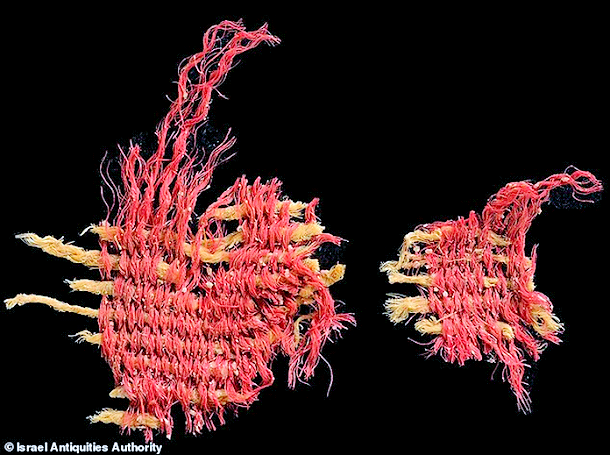
The dye was made from the bodies and eggs of scarlet-colored scale insects. Female kermes insects, which are similar to cochineal scale, attach themselves to the kermes oak and produce carminic acid, the pigment responsible for the dye’s deep red hue. In biblical terminology, this scarlet dye is called shani, and more fully, tola’ath shani, expressions commonly translated as “crimson” or “scarlet worm.”

Because shani is the color of blood, it came to hold particular significance in biblical imagery. “Blood” frequently signified “guilt, violence, wrongdoing, and especially the shedding of innocent life.” “Scarlet,” then, was much more than a simple term for the color red. It became “a vivid visual metaphor for moral defilement and the stain of sin.”
Isaiah 1:15: “When you lift up your hands in prayer, I will not look. Though you offer many prayers, I will not listen, for your hands are covered with the blood of innocent victims.”
REFLECT & PRAY
Genuine prayer resembles a meaningful conversation between two people. It is a living exchange between God and us that lies at the very heart of prayer.
Father, thank You for providing a way for the scarlet stains of my life to be washed away completely. Thank You for awakening my mind, bringing me to my senses, and calling me to be made right according to Your will.
INSIGHT
Bloodguilt and Moral Defilement
In Isaiah 1:15, the Father confronts the nation of Israel and declares that their acts of worship are unacceptable because their hands are marked by bloodguilt. Their outward religion cannot conceal their inward corruption. He refuses to hear their prayers, not because prayer itself is powerless, but because they persist in evil while attempting to approach Him through empty ritual. Fellowship can be restored only after cleansing and repentance.
In the Old Testament, the concept of bloodguilt holds great significance. It refers to the moral and legal guilt that arises from the wrongful taking of an innocent life. More than just a violation of law, bloodguilt represents a deep moral corruption in the eyes of God and creates a lasting burden on the perpetrator’s conscience. It defiles the individual and leaves a lasting stain that cries out for punishment. There is no single English word that captures the full weight and seriousness of this idea.
This is what makes Isaiah’s imagery so compelling. Just as dried blood and crimson stains are notoriously difficult to remove, so too does bloodguilt appear seemingly impossible to erase. If bloodguilt leaves such a deep and lasting mark, how can the one who bears it ever be made clean? Humanly speaking, the answer would seem hopeless. Yet the Father Himself offers what sinners cannot achieve on their own.
Isaiah 1:18: “Says the LORD, ‘Though your sins are like scarlet, I will make them as white as snow. Though they are red like crimson, I will make them as white as wool.’”
The promise is remarkable in its scope. The Father does more than conceal guilt or make it less visible; He removes the stain itself and the guilt that accompanies it. This imagery depicts a complete moral cleansing, not superficial improvement. Garments once soaked in scarlet become white; what seemed stained beyond repair is made pure, clean, and undefiled.
The Necessity of Divine Cleansing
The imagery is unmistakably clear: when we stand truly guilty before God, we are powerless to cleanse ourselves. No amount of effort, self-justification, denial, or religious activity can remove moral defilement; only divine intervention can do that. Sin cannot be hidden beneath a respectable appearance; it must be taken away and replaced with genuine purity. What is as visible and undeniable as scarlet against white must be washed away by the Father Himself.
At the same time, this promise of cleansing cannot be separated from repentance. The Father offers forgiveness and restoration to Israel, but these blessings depend on sincerely turning away from rebellion and returning to Him in faith and obedience. He is fully willing to forgive, but always according to His own holy terms.
Israel’s error was to imagine that outward sacrifice could make up for inward corruption. They presumed they could live as they pleased as long as they maintained the proper religious forms. But ritual without repentance is empty. God desired not mechanical religious observance, but obedience, humility, and a heart rightly ordered toward Him and others.
David’s Example of Repentance
King David understood this truth. After the prophet Nathan confronted him about his sin with Bathsheba and the murder of Uriah, David could no longer conceal his guilt behind silence, power, or position. He stood exposed before God. Rather than defend himself or offer excuses, he humbled himself and threw himself entirely upon divine mercy. He came to the Father in brokenness, dependence, and sincere appeal to His steadfast love.
Psalms 51:1-4:
“Have mercy on me, O God, because of your unfailing love. Because of your great compassion, blot out the stain of my sins. Wash me clean from my guilt. Purify me from my sin. For I recognize my rebellion; it haunts me day and night.
I have sinned against you, and you alone; I have done what is evil in your sight. You will be proved right in what you say, and your judgment against me is just.”
David’s words reveal the depth of his anguish. He is haunted by the weight of his sin, and his conscience is profoundly pierced by guilt. He recognizes that his offense is real, his stain is personal, and God’s judgment is entirely just. His repentance is not superficial remorse, but a deep awareness that his sin has ruptured his fellowship with the Father.
In this respect, his condition invites comparison with Lady Macbeth, who, tormented by conscience, cries, “Out damned spot,” as she desperately tries to wash away the blood she imagines on her hands, consumed by an invisible guilt she cannot escape.
David, too, feels the crushing reality of moral stain. Yet the outcome is radically different. Macbeth and Lady Macbeth descend into ruin, but David turns to the Father in genuine repentance and receives mercy. He is not left crushed by the burden of his guilt; he is gloriously cleansed.
Psalms 51:7: “Purify me from my sins, and I will be clean; wash me, and I will be whiter than snow.”
This hope is offered to every child of the King. No matter how grievous the sin or how dark the stain, the Father can cleanse, forgive, and restore.
The Father’s Invitation
How, then, is such cleansing possible? The answer begins with the Father’s own gracious invitation.
Isaiah 1:18: “‘Come now, and let us reason together,’ Says the LORD.”
He calls His people to face their true condition before Him and respond with honesty and humility. They are invited to take their guilt seriously while recognizing His willingness to restore them. Though the text does not yet fully explain how this transformation will occur, it makes one truth unmistakably clear: the Father Himself will do what sinners cannot do for themselves. The restoration of fellowship depends on His power to cleanse and on the sinner’s willingness to turn from rebellion and return to Him in faith and obedience.
Christ and the Cleansing of Sinners
This promise of cleansing finds its fullest and final expression in the Lord Christ Jesus. What Isaiah foreshadowed, the gospel fulfills. The Father’s willingness to remove even the deepest guilt is more than a theological idea or poetic image; it is a redemptive reality made possible by the coming of His Son.
1 Timothy 1:15: “Christ Jesus came into the world to save sinners – and I am the worst of them all.”
This is the heart of the good news: Christ Jesus came especially for those marked by sin and burdened by guilt. He came for the defiled, the condemned, and the morally broken. So, no stain is too deep, no guilt too great, and no life so ruined that it cannot be cleansed by the mercy of God.
¯\_(ツ)_/¯8-07-4
© Dr. H 2026

