
Indomitable Courage
My servant Caleb has a different attitude than the others have. He has remained loyal to me, so I will bring him into the land he explored. His descendants will possess their full share of that land. – Numbers 14:24
Joshua 14:9-12
Moses solemnly promised me, ‘The land of Canaan on which you were just walking will be your grant of land and that of your descendants forever because you wholeheartedly followed the LORD my God.’
Now, as you can see, the LORD has kept me alive and well as he promised for all these forty-five years since Moses made this promise – even while Israel wandered in the wilderness. Today I am eighty-five years old.
I am as strong now as I was when Moses sent me on that journey, and I can still travel and fight as well as I could then.
So give me the hill country that the LORD promised me. You will remember that as scouts, we found the descendants of Anak living there in great, walled towns. But if the LORD is with me, I will drive them out of the land, just as the LORD said.
What is Indomitable Courage?
Indomitable courage is a recurring theme in history, literature, and the Scriptures. It is celebrated as a personal quality that enables people to respond nobly and with integrity in the face of great loss or danger.
- “Indomitable courage enables ordinary people to do extraordinary things in difficult times.”
- “Indomitable courage is the quiet strength that refuses to surrender when the path grows dark.”
- “Indomitable courage does not deny fear; it masters fear and keeps moving forward.”
- “The mark of true character is indomitable courage in the face of relentless adversity.”
- “Indomitable courage turns obstacles into proving grounds for faith, endurance, and resolve.”
- “Where talent may falter, and confidence may waver, indomitable courage endures.”
- “Indomitable courage is the soul’s refusal to be conquered by fear, pain, or uncertainty.”
In simple terms, “indomitable courage” is “the ability to stand firm in the face of fear, pain, or opposition.” It means “refusing to be inwardly conquered, even under severe circumstances.” At its core, “it is an unconquerable heart,” which is essential for living faithfully, leading effectively, suffering nobly, and persevering through hardship.
The term “indomitable” means “unconquerable or unyielding,” suggesting that “a type of courage is not a fleeting moment of bravery but a sustained moral and emotional resolve.” Someone with indomitable courage may feel fear but does not let it dictate their choices.
“Indomitable” comes from the Latin word indomitus, meaning “untamed.” And “courage” is derived from the Latin term cor, meaning “heart.” Together, they describe “a heart that stays strong and unyielding under pressure.”
Indomitable courage is neither rooted in stubborn pride nor recklessness. It doesn’t ignore danger or deny that pain is real. Instead, it recognizes the weight of hardship and remains steadfast.
Indomitable courage is deliberate and disciplined, rooted in principle rather than impulse.
Leonidas of Sparta: A King who Defied an Empire and Stood His Ground
Leonidas of Sparta remains one of history’s most compelling portraits of indomitable courage. Shaped by the rigorous discipline of Spartan life, he ascended the throne as Greece faced its gravest peril. In 480 BC, Xerxes assembled an army of roughly 100,000 to 200,000 soldiers to conquer Greece. Leonidas led 300 Spartans and about 1,000 other Greek troops.
The Stand at Thermopylae
Leonidas led three hundred Spartans in a defiant stand against the immense Persian army by blocking a narrow pass. They held off wave after wave of attacks with unwavering discipline. But when a traitor revealed a hidden mountain path, their position became untenable. Rather than retreat, Leonidas chose to stay and fight to the last man. Leonidas knew the odds were impossible yet faced them without flinching. His sacrifice bought Greece precious time to regroup and prevail.
Ultimately, true courage is measured not by victory but by the determination to remain faithful to one’s duty, even when defeat seems inevitable. Leonidas remains a timeless hero, embodying courage and duty regardless of the cost.
REFLECT & PRAY
A pessimist complains about the wind.
An optimist expects the wind to change.
A realist makes adjustments.
Father, with You all things are possible. In these dark and troubling days, it is easy to become afraid, even overwhelmed. I pray that You would grant me the same indomitable courage You gave to Joshua and Caleb.
INSIGHT
Courage in the Face of Fear
Before Israel’s entrance into Canaan, the Father instructed Moses to send twelve spies, one from each tribe, to examine the land and assess its inhabitants. Numbers 13:1-2:
“The Lord now said to Moses, ‘Send out men to explore the land of Canaan, the land I am giving to the Israelites. Send one leader from each of the twelve ancestral tribes.’”
Their assignment was simply to gather facts, not to judge whether the Father’s promise could be fulfilled.
What they found confirmed the land’s abundance. Canaan was truly fruitful, a land flowing with milk and honey. Yet it was also strongly fortified and occupied by formidable warriors, including people the spies regarded as giants. Confronted with these realities, ten of the twelve spies yielded to fear. Their report moved beyond observation into despair, unbelief, and exaggeration. Certain that any attempt to invade would end in disaster, they urged the people to abandon the mission.
The Evil Report
The great tragedy of the moment was not merely that the spies were afraid, but that their fear eclipsed their trust in the Father. They measured the challenge by human strength alone and forgot the One who had brought them this far.
Numbers 13:31-33:
“We can’t go up against them! They are stronger than we are!” “So they spread this evil report about the land among the Israelites: ‘The land we traveled through and explored will devour anyone who goes to live there. All the people we saw were huge.’” “We even saw giants there, the descendants of Anak. Next to them, we felt like grasshoppers, and that’s what they thought, too!”
Their evil report reveals how fear can distort perspective. The spies did more than report facts; they viewed them through the lens of unbelief. What should have been an opportunity for trust instead became a moment of panic, retreat, and exaggeration. Their response highlights the difference between viewing obstacles through fear and seeing them through faith.
Joshua and Caleb’s Different Spirit
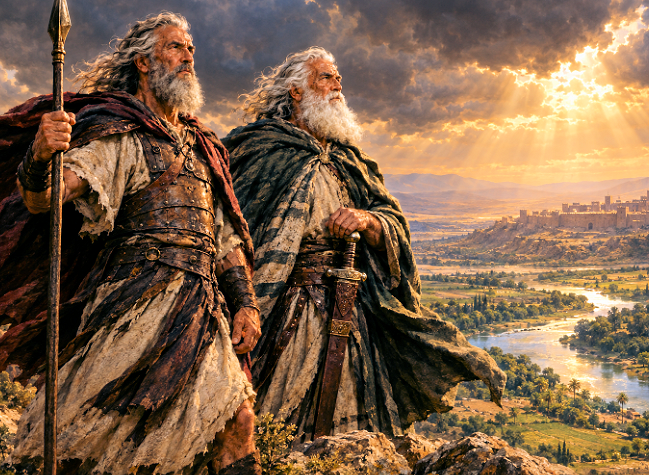
Joshua and Caleb saw the same land, cities, soldiers, and giants. Yet they viewed what they saw through the lens of faith rather than fear. Their confidence rested not on Israel’s military strength, but on the Father’s presence and power. What seemed impossible to men posed no obstacle to the Lord God Almighty. To them, refusing to enter the land was not caution; it was rebellion.
Numbers 14:6-9:
“Two of the men who had explored the land, Joshua, son of Nun, and Caleb, son of Jephunneh, tore their clothing.” “They said to all the people of Israel, ‘The land we traveled through and explored is a wonderful land!’” “And if the Lord is pleased with us, he will bring us safely into that land and give it to us. It is a rich land flowing with milk and honey.” “Do not rebel against the Lord, and don’t be afraid of the people of the land. They are only helpless prey to us! They have no protection, but the Lord is with us! Don’t be afraid of them!”
Their courage was not naïve optimism; it was realism rooted in faith. They recognized the danger, but they also recognized the greatness of the Father.
The Cost of Unbelief
The people of Israel chose to believe the fearful report of the majority instead of the faithful words of Joshua and Caleb. By rejecting God’s promise, they turned a moment of victory into a season of judgment. They were condemned to wander in the wilderness for forty years, until the adults responsible for their rebellion had died; only Joshua and Caleb were spared. This account is a stark reminder that fear and unbelief can keep people from receiving the blessings set before them.
Joshua Commissioned to Lead
After the death of Moses, Joshua was chosen to lead Israel. The Father Himself commissioned him for the task. Joshua 1:1-3:
“The Lord spoke to Joshua, son of Nun, Moses’ assistant. He said, ‘Moses, my servant is dead. Therefore, the time has come for you to lead these people, the Israelites, across the Jordan River into the land I am giving them. I promise you what I promised Moses: “Wherever you set foot, you will be on land I have given you.”‘”
Joshua’s leadership began with a divine charge centered on courage and obedience.
Joshua 1:7: “Be strong and very courageous. Be careful to obey all the instructions Moses gave you. Do not deviate from them, turning either to the right or to the left. Then you will be successful in everything you do.”
This was not a call for reckless boldness, but for an indomitable courage grounded in faithfulness and shown through obedience to the Father’s word.
Caleb’s Enduring Strength
Caleb was a striking example of courageous faith. He was not content merely to have survived the wilderness. At eighty-five, he stood ready to confront the giants of the hill country promised him through the power of Almighty God.
Caleb began well and finished well.
Numbers 14:24: “But my servant Caleb has a different spirit than the others have. He has remained loyal to me, so I will bring him into the land he explored.”
True Strength Comes from Indomitable Will
Joshua and Caleb remain enduring witnesses to the power of indomitable courage and faith. They did not deny the danger, but they refused to let it define reality. While others were overcome by fear, they remained grounded in the Father’s promises and faithfulness. Their example calls us to reject the paralysis of unbelief and move forward in obedience, even when the path ahead seems daunting.
Gandhi boldly wrote that, “Strength does not come from physical capacity. It comes from indomitable will.”
¯\_(ツ)_/¯
© Dr. H 2026

