
Ersatz Children ∙∙∙

Ersatz Children ∙∙∙

The LORD used to speak to Moses face to face, just as a man speaks to his friend. – Exodus 33:11

Numbers 16:28-35

And Moses said, “This is how you will know that the LORD has sent me to do all these things that I have done – for I have not done them on my own. If these men die a natural death, or if nothing unusual happens, then the LORD has not sent me.

But if the LORD does something entirely new and the ground opens its mouth and swallows them and all their belongings, and they go down alive into the grave, then you will know that these men have shown contempt for the LORD.”

He had hardly finished speaking the words when the ground suddenly split open beneath them. The earth opened its mouth and swallowed the men, along with their households and all their followers who were standing with them, and everything they owned.

Then fire blazed forth from the LORD.

The Formation and Structure of Icebergs

Each year, more than 10,000 icebergs are formed in the northern hemisphere, originating from the Arctic’s frozen landscapes. These icebergs vary dramatically in size, from as small as a piano to as massive as a 10-story building. Despite their imposing appearance, what we see above the water is only a fraction of their actual size.

Approximately 10% of an iceberg’s total volume is visible above the waterline, while the remaining 90% lies hidden beneath the surface. The visible portion, often referred to as the tip of the iceberg, is composed of low-density snow and ice. Beneath the water, the denser core remains concealed. This phenomenon occurs because the densities of ice and seawater are very close, causing the ice to float low in the water.

The phrase “Tip of the iceberg” has become a metaphor in everyday language, symbolizing situations where only a small, visible part of a larger, hidden reality is apparent. Beneath the surface often lies a much more significant, unseen portion.

The Hidden Motives of Rebellion in Scripture

The Scriptures are replete with accounts of rebellion, envy, and deceit. Often, these actions are not committed by genuine believers but by false brothers and sisters, false teachers, or false apostles, artificial imitations of children of the King. These ersatz followers, artificial and inferior substitutes, often hide their true motives behind superficial justifications.

Sometimes, rebellion and opposition are driven by two layers of motives: the “Stated reason” and the “Hidden reason.” The stated reason is the visible tip of the iceberg, the justification shown to others. The hidden agenda, however, is the deeper, secret motive. It’s usually rooted in selfish ambition, greed, or a desire for power and recognition.

This pattern of self-centered ambition recurs throughout Scripture. Examples include:

Absalom’s defiance of his father, David (2 Samuel 15)

Adonijah’s attempt to seize David’s throne (1 Kings 1)

The disciples’ debate over who was the greatest (Luke 22:44)

Diotrephes’s sinful ambition to dominate his local assembly (3 John 1:9-10)

The Rebellion of Korah, Dathan, and Abiram

One of the most notable examples of rebellion in Scripture is the story of Korah, Dathan, and Abiram, recorded in Numbers. These three individuals challenged Moses and Aaron with arrogance and deceit, questioning their God-given authority.

Korah, in particular, refused to acknowledge that the Father had chosen Moses as His representative and spokesman. Instead, Korah projected his own sinful ambitions onto Moses, accusing him and Aaron of elevating themselves above the rest of the people. Korah publicly argued that leadership should be more inclusive, claiming that others should have a say in guiding Israel. This was his “stated reason,” the visible tip of the iceberg.

However, Korah’s “hidden reason” was far more self-serving. As a Levite, Korah already had significant responsibilities assisting the Aaronic priesthood, but he was not content with his role. He desired more power and recognition, craving the privileges of the priesthood for himself. His ambition to stay in the spotlight and his dissatisfaction with his position ultimately fueled his rebellion.

Numbers 16:10 explains,“The Lord has already given you this special ministry to serve in the Lord’s Tabernacle and to stand before the people to minister to them. Is it not enough for you?”

REFLECT & PRAY

As children of the King, the most important position in life is the one that the Father has prepared for us. In His eyes, character, loyalty, and faithfulness are what truly matter. While status, recognition, wealth, and power may seem significant to people, they do not determine our worth before the Father. Numbers 16:5: “The Lord will show who belongs to him and who is holy, and he will have that person come near him.”

Father, You alone have the sovereign right to decide who leads and who does not. Your choices are purposeful and wise, calling for our submission and trust in His plan.

INSIGHT

False Apostles and Their Motives

Paul describes his opponents as “false apostles” (pseudapostoloi) and “false brothers” (pseudadelphoi), emphasizing their “deceitful nature and self-serving motives” (2 Corinthians 11:13, 26). In the New Testament era, false apostles, prophets, and teachers (2 Peter 2:1) often resembled the arrogance and ambition of Korah.

Responding to False Leaders

When faced with false accusations and opposition, Numbers 16:4 notes that Moses did not engage in argument or self-defense. Instead, he fell flat on his face before the Father, seeking justice and vindication through prayer. Moses entrusted the matter to the Father, showing humility and reliance on divine intervention.

Korah, Dathan, and Abiram faced a devastating outcome. The Father’s judgment was quick and definitive. The earth opened up beneath them, swallowing them and their families, while fire from heaven finished their destruction. Conversely, Moses, as the Father’s chosen leader and friend, was justified. This serves as a powerful object lesson: arrogance and pride result in failure and ruin, while humility and trusting dependence on the Father are honored.

Proverbs 16:18 asserts that“Pride goes before destruction and haughtiness before a fall.”

While James 4:10 shows us the way to honor,“Humble yourselves before the Lord, and he will lift you up in honor.”

Rebelling against the Father’s chosen leaders is ultimately rebelling against Him. Challenging His authority or opposing His anointed ones is both foolish and dangerous.

Hebrews 10:31 warns that “It is a terrifying thing to fall into the hands of the living God.”

The Hidden Motives Within

Reflecting on the nature of icebergs, we are reminded that much of what lies beneath the surface remains unseen. Likewise, hidden reasons and secret agendas often lurk within our hearts. Sometimes, we don’t even know our own motives. A person who is deceived doesn’t know they are deceived, and the Scriptures highlight the problem of self-deception.

Jeremiah 17:9-10: “The human heart is the most deceitful of all things and desperately wicked. Who really knows how bad it is? But I, the LORD, search all hearts and examine secret motives.”

The human heart is inherently deceitful, often hiding its darker tendencies. Yet the Father carefully searches the depths of our innermost selves, uncovering the secrets within us. Nothing escapes His sight.

This raises an important question: how can we truly understand the deceptive qualities of our own hearts? Additionally, what actions can we take to eliminate hidden motives and agendas?

The Role of God’s Word in Revealing the Heart

The Word of God is a powerful tool for revealing the hidden layers of our hearts. It goes deep, uncovering our innermost thoughts and desires. Through Scripture, the Father brings to light what is buried within us, helping us confront and address our hidden motives.

Hebrews 4:12: “For the word of God is alive and powerful. It is sharper than the sharpest two-edged sword, cutting between soul and spirit, between joint and marrow. It exposes our innermost thoughts and desires.”

Investing time in the Scriptures invites the Father to unveil the truths of our hearts. By engaging with the Word, we gain profound insights into our nature, which equip us to confront and better handle what is uncovered. Through prayer and a heart that is responsive to His guidance, we can address and overcome the hidden motives within.

The story of Korah and his rebellion serves as a powerful reminder of the dangers of hidden motives and selfish ambition. Just as the tip of an iceberg conceals a much larger mass beneath the surface, the visible actions of rebellion often mask deeper, self-serving intentions. The Father calls His children to humility, faithfulness, and trust in His sovereign will.

How’d They Do That? ∙∙∙-

How’d They Do That? ∙∙∙

He makes me as sure-footed as a deer, enabling me to stand on mountain heights. – Psalms 18:33

Psalms 119:133 When a man’s conduct pleases him, the Lord enables him to go through life with confidence (FRCL).

Matthew 18:4-7

Anyone who becomes as humble as this little child is the greatest in the Kingdom of Heaven. And anyone who welcomes a little child like this on my behalf is welcoming me.

But if you cause one of these little ones who trusts in me to fall into sin, it would be better for you to have a large millstone tied around your neck and be drowned in the depths of the sea. What sorrow awaits the world because of its stumbling blocks, which tempt people to sin. Temptations are inevitable, but what sorrow awaits the person who does the tempting.

The Remarkable Agility of Mountain Goats

Mountain goats in North America possess an extraordinary ability to climb nearly vertical cliffs effortlessly. As Douglas Chadwick aptly described, they might be “the most accomplished and consummate climbers to ever inhabit any continent.” Erica Tennenhouse further highlights their grace, noting, “Mountain goats can powerfully scale up the most precipitous slopes with the grace of hooved ballerinas.” Their unmatched talent for vertical ascent sets them apart as nature’s ultimate climbers.

Designed for the Heights

Mountain goats are intelligently designed to climb nearly vertical cliffs. They thrive in harsh, rocky environments where few other animals can survive. Their agility and strong grip allow them to ascend steep slopes quickly, gaining about 75 feet in height in just one minute. Their hooves are uniquely specialized for this task. The tough outer shell provides a solid grip on tiny ledges, while the soft pads underneath conform to the mountain’s surfaces, functioning much like modern climbing shoes. Plus, their slender bodies help them stay balanced on narrow, almost invisible ledges. 

2 Samuel 22:34: “He makes me as sure-footed as a deer, enabling me to stand on mountain heights.”

The Biblical Context of Surefootedness

The Hebrew word translated as “deer” or “hind” in 2 Samuel 22:34 is ayyalah. The term ayyalah appears only eight times in the Old Testament and refers to a species of deer recognized throughout the ancient Near East. Before Linnaeus developed the modern classification system in the 18th century, animals were often categorized by their functional traits. As a result, agile and sure-footed creatures such as sheep, goats, ibex, deer, and gazelles were commonly grouped together.

In ancient Israel, the local population would not have encountered the North American mountain goat, known for its remarkable climbing abilities. Had they encountered such an animal, it is conceivable that Scripture would have referred to the mountain goat rather than the deer or hind. Nonetheless, the creatures mentioned in the Old Testament became symbols of agility and grace. Much like contemporary phrases such as “fast as lightning,” these animals represented not only speed but also stability.

The Opposite of Surefootedness

Surefootedness embodies stability, confidence, and grace, while its antithesis, bumbling and stumbling, reflects clumsiness. This stark contrast highlights the importance of walking, intentionality, and steadiness in both our physical movements and spiritual development.

REFLECT & PRAY

The Father takes great joy in His children and wishes for them to live with a sense of triumph and fulfillment.

Father, I am prone to stumbling in my walk with You.  Please guide my steps in alignment with Your word, so that evil will not overcome me.

INSIGHT

The Nature of Stumbling Blocks

The world is filled with stumbling blocks, obstacles that slow progress, cause difficulty, or lead to hesitation. These barriers can take many forms, from physical impediments like boulders, rocks, or fallen trees to intangible challenges such as emotional struggles, societal pressures, the unrelenting pain of aging, and unforeseen circumstances. Stumbling blocks are anything that disrupts or slows our forward movement, often affecting our spiritual walk with the Father.

As children of the King, we are not immune to facing stumbling blocks. Even the most steady-footed among us can stumble without the Father’s guidance and strength.

Psalms 18:32-33: promises, “God arms me with strength, and he makes my way perfect. He makes me as sure-footed as a deer, enabling me to stand on mountain heights.”

Strength and Safety in the Father

True safety is not the absence of danger but the presence of the Father. He provides the strength and stability needed to navigate life’s challenges. His guidance enables us to walk confidently, even on the most dangerous paths.

The prophet Habakkuk proclaims in Habakkuk 3:19, “The Sovereign LORD is my strength! He makes me as sure-footed as a deer, able to tread upon the heights.”

To become sure-footed in life’s trials, we must develop a deep, trusting relationship with the Father through the Lord Jesus Christ. This relationship gives us supernatural insight and discernment, equipping us to walk circumspectly and navigate life’s challenges with grace and wisdom.

Ephesians 5:15 cautions, “So be careful how you live. Don’t live like fools, but like those who are wise.”

Living in the Father’s presence provides a deep sense of security. Every step, big or small, is led by His wisdom. Though we may stumble, we are never left alone. The Father is always there to steady us, preventing total destruction.

In Psalms 37:23-24, David asserts that “The LORD directs the steps of the godly. He delights in every detail of their lives. Though they stumble, they will never fall, for the LORD holds them by the hand.”

Protecting the Vulnerable from Stumbling

As the children of the King develop strength and assurance, they are entrusted with the duty of protecting the vulnerable and preventing others from faltering. The Father offers clear guidance for living with integrity and compassion, underscoring the importance of safeguarding those who are weak or disadvantaged.

Leviticus 19:14 cautions, “You must not curse a deaf person or put a stumbling block in front of a blind person. You must fear your God; I am the LORD.”

The Father’s care extends to those with physical limitations, ensuring their needs and dignity are protected. This principle also applies to the young and innocent, who are particularly vulnerable to harm.

Matthew 18:6: “But if you cause one of these little ones who trusts in me to fall into sin, it would be better for you to have a large millstone tied around your neck and be drowned in the depths of the sea.”

The Father places a high priority on safeguarding the vulnerable. As a caring and devoted shepherd, He serves both as a source of support for those in need and as a guardian against injustice. His inherent nature calls for a balance of justice and compassion, establishing a guiding principle for the children of the King to emulate.

The Standard of Righteousness

The Father, as the ultimate Lawgiver, sets boundaries on our freedom to protect the well-being of others. Causing harm to the vulnerable is not simply a mistake; it is an act of iniquity, something fundamentally wrong. In simple terms, we might say, “That’s not right.” Wickedness challenges our natural sense of morality, as long as our consciences are clear.

When approached with wisdom and sagacity, obstacles can become opportunities for growth. With the Father’s guidance, what once appeared daunting, if not seemingly insurmountable, can become a catalyst for personal progress and praise. Onlookers may be amazed, asking, “How did they do that?” as they see the powerful ways God works in our lives.

The biblical image of sure-footed animals serves as a compelling metaphor for spiritual steadiness and confidence. Just as mountain goats are built to climb challenging terrain, children of the King are encouraged to rely on God’s guidance to face life’s challenges safely.

¯_(ツ)_/¯6-23-3

© Dr. H 2026

A Lost Sheep Found ∙∙-

A Lost Sheep Found ∙∙

If a man has a hundred sheep and one of them gets lost, what will he do? Won’t he leave the ninety-nine others in the wilderness and go to search for the one that is lost until he finds it? – Luke 15:4

John 15:1-5

I am the true vine, and my Father is the gardener. He cuts off every branch of mine that doesn’t produce fruit, and he prunes the branches that do bear fruit so they will produce even more. You have already been pruned and purified by the message I have given you. Remain in me, and I will remain in you.

For a branch cannot produce fruit if it is severed from the vine, and you cannot be fruitful unless you remain in me. Yes, I am the vine; you are the branches. Those who remain in me, and I in them, will produce much fruit.

Apart from me, you can do nothing.

The Remarkable Recovery of Baarack: A Modern Parable

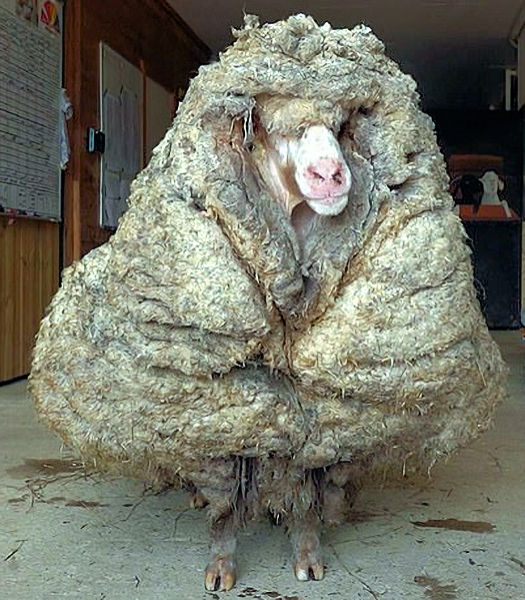
In February 2021, a lost sheep was found after nearly five years wandering through the Australian bush. Rescuers named the sheep Baarack, and they were amazed to discover that it had grown an incredible 77 pounds of dense fleece. The weight of its dirty, matted wool, caked with years of mud and debris, made it difficult for Baarack to stand or walk.

Unlike their wild ancestors, the mouflon found in Europe and Asia, modern domesticated sheep have been selectively bred over centuries to produce fleece that must be sheared rather than naturally shed. While wild mouflon have a rough outer coat and a soft undercoat that provides natural insulation, allowing them to shed in warmer months, domesticated sheep depend on human intervention. This change fundamentally altered their lives: Today’s sheep rely entirely on human care to keep their coats healthy and ensure their well-being, requiring regular shearing to prevent a fate like Baarack’s.

When the layers of fleece were removed, a torn ear, where an identification tag once hung, was first seen. This indicated that Baarack had once belonged to someone. Despite living wild for years, Baarack was still a domesticated sheep.

Biblical Imagery of Care and Dependence

Scripture uses vivid analogies to illustrate the relationship between children of the King and the Father, emphasizing roles such as Father-Child, Husband-Wife, Vine-Branches, Vinedresser-Branches, and Shepherd-Sheep. Each metaphor highlights the intimacy and dependence characteristic of this relationship.

As “Sheep of His pasture,” children of the King rely on His attentive care, similar to branches thriving on a vine under the watchful eye of a vinedresser. We need consistent nurturing, pruning, and guidance to truly flourish. Through this ongoing relationship, our lives can become fruitful and strong, much like grapevine branches that produce a bountiful harvest through careful cultivation.

REFLECT & PRAY

Only two things on Earth that are eternal: human souls and the Word of God. Everything else is temporary or fleeting.

Father, prune and shape my life so I stay rooted in the Lord Jesus Christ and bear lasting fruit that endures forever.

INSIGHT

Understanding Our Relationship with the Father

Knowing the Father, walking with Him, and maturing in faith are deeply rooted in relationship. Every child of the King is uniquely designed to live in a symbiotic relationship with the Father. We are not meant to be independent or detached from Him. Unlike wild sheep, we are domesticated and need a shepherd’s care and guidance.

The story of Baarack, a sheep that wandered off and became burdened by an overgrown fleece, vividly illustrates what happens when we pull away from the Father’s tender, loving care.  Even as members of His flock, we still exhibit sheep-like behaviors, which can result in unfavorable consequences if we wander.

Isaiah 53:6: “All we like sheep have gone astray; we have turned to our own way.”

The Vine and the Vinedresser

We are not like wild grapes. Instead, we resemble cultivated grapevines that require a skilled vinedresser’s care to reach their full potential. Cultivated grapevines are carefully nurtured to produce the highest possible harvest, which then leads to optimal wine production. As the divine Vinedresser, the Father takes two essential steps to ensure we bear fruit: He removes unfruitful branches and prunes the fruitful ones to increase their productivity.

John 15:2: “He cuts off every branch of mine that doesn’t produce fruit, and he prunes the branches that do bear fruit so they will produce even more.”

The Importance of Pruning

A little background on grapevines helps clarify this analogy. If left untrimmed, grapevines naturally develop long, woody branches that channel their energy into branch growth instead of grape production. This results in sparse, underwhelming grape clusters. Early winemakers learned that severe pruning redirected the vine’s energy, encouraging it to focus on producing abundant, high-quality grapes rather than excessive branches.

Pruning typically takes place in midwinter, resulting in bare fields dotted with small stumps. This essential process readies the vines for the upcoming spring growing season. The cut branches are collected and burned, allowing the vines to grow freely from their established stumps each year.

Lessons from the Vine and the Branches

What insights can we derive from these scriptural analogies regarding our relationship with the Father?

The underlying message is clear: as children of the King, it is essential for us to invite the divine Vinedresser to guide and shape our lives. Much like a grapevine that flourishes through careful pruning and nurturing, we too can thrive when we focus our energies on meaningful pursuits and deepen our connection with Him.

The metaphor of the vine and branches would have resonated deeply with the original audience. This teaching goes beyond simple agricultural principles, providing a rich understanding of how to cultivate a vibrant relationship with the Father. The ultimate goal is not just to establish a connection but to produce an abundance of spiritual fruit that reflects the depth of that relationship.

The Consequences of Straying

Sheep need regular shearing, and vine branches must be carefully pruned to thrive. When we stray from the shepherd’s caring guidance or ignore His direction, we risk becoming like Baarack, burdened, unproductive, and increasingly distant from the Father. As branches of the vine, we face a crucial choice: stay connected to our source and produce abundant fruit, or become unproductive and ultimately useless.

But how does one become insignificant? Resistance, distraction, and the refusal to follow the Father’s guidance cause us to weaken. A lukewarm or superficial faith, marked by empty words without action, results in leaves without fruit. When we turn away from our faith or neglect to act on the principles we believe in, we risk becoming completely ineffective and unproductive.

John 15:5: “For apart from me you can do nothing.”

What Does “Nothing” Mean?

The Lord Jesus Christ does not mean “nothing at all,” as we can still perform regular activities of life without Him. Instead, He is referring to “nothing of eternal value” or an inability to produce spiritual fruit (ESV notes).

As William Barclay rightly notes, “Uselessness invites disaster.”

A Call to Fruitfulness

The Father desires us to succeed, produce fruit, and live lives of eternal significance. By maintaining a connection with Him and allowing His pruning and shaping, we can achieve our purpose and experience a fulfilling life rooted in His love and care. Let us embrace His role as the divine Vinedresser, trusting His wisdom and guidance to steer us toward abundant spiritual fruitfulness.

Modern sheep are representative of our dependence on the Father’s wisdom, care, and provision. Just as domesticated sheep cannot flourish without a shepherd’s guidance, we must stay close and connected to Christ, our good Shepherd and source of life, meaning, and growth.

¯_(ツ)_/¯9-26-3

© Dr. H 2026

How’d They Do That? ∙∙∙

How’d They Do That? ∙∙∙

He makes me as sure-footed as a deer, enabling me to stand on mountain heights. – Psalms 18:33

Psalms 119:133 When a man’s conduct pleases him, the Lord enables him to go through life with confidence (FRCL).

Matthew 18:4-7

Anyone who becomes as humble as this little child is the greatest in the Kingdom of Heaven. And anyone who welcomes a little child like this on my behalf is welcoming me.

But if you cause one of these little ones who trusts in me to fall into sin, it would be better for you to have a large millstone tied around your neck and be drowned in the depths of the sea. What sorrow awaits the world because of its stumbling blocks, which tempt people to sin. Temptations are inevitable, but what sorrow awaits the person who does the tempting.

The Remarkable Agility of Mountain Goats

Mountain goats in North America possess an extraordinary ability to climb nearly vertical cliffs effortlessly. As Douglas Chadwick aptly described, they might be “the most accomplished and consummate climbers to ever inhabit any continent.” Erica Tennenhouse further highlights their grace, noting, “Mountain goats can powerfully scale up the most precipitous slopes with the grace of hooved ballerinas.” Their unmatched talent for vertical ascent sets them apart as nature’s ultimate climbers.

Designed for the Heights

Mountain goats are intelligently designed to climb nearly vertical cliffs. They thrive in harsh, rocky environments where few other animals can survive. Their agility and strong grip allow them to ascend steep slopes quickly, gaining about 75 feet in height in just one minute. Their hooves are uniquely specialized for this task. The tough outer shell provides a solid grip on tiny ledges, while the soft pads underneath conform to the mountain’s surfaces, functioning much like modern climbing shoes. Plus, their slender bodies help them stay balanced on narrow, almost invisible ledges. 

2 Samuel 22:34: “He makes me as sure-footed as a deer, enabling me to stand on mountain heights.”

The Biblical Context of Surefootedness

The Hebrew word translated as “deer” or “hind” in 2 Samuel 22:34 is ayyalah. The term ayyalah appears only eight times in the Old Testament and refers to a species of deer recognized throughout the ancient Near East. Before Linnaeus developed the modern classification system in the 18th century, animals were often categorized by their functional traits. As a result, agile and sure-footed creatures such as sheep, goats, ibex, deer, and gazelles were commonly grouped together.

In ancient Israel, the local population would not have encountered the North American mountain goat, known for its remarkable climbing abilities. Had they encountered such an animal, it is conceivable that Scripture would have referred to the mountain goat rather than the deer or hind. Nonetheless, the creatures mentioned in the Old Testament became symbols of agility and grace. Much like contemporary phrases such as “fast as lightning,” these animals represented not only speed but also stability.

The Opposite of Surefootedness

Surefootedness embodies stability, confidence, and grace, while its antithesis, bumbling and stumbling, reflects clumsiness. This stark contrast highlights the importance of walking, intentionality, and steadiness in both our physical movements and spiritual development.

REFLECT & PRAY

The Father takes great joy in His children and wishes for them to live with a sense of triumph and fulfillment.

Father, I am prone to stumbling in my walk with You.  Please guide my steps in alignment with Your word, so that evil will not overcome me.

INSIGHT

The Nature of Stumbling Blocks

The world is filled with stumbling blocks, obstacles that slow progress, cause difficulty, or lead to hesitation. These barriers can take many forms, from physical impediments like boulders, rocks, or fallen trees to intangible challenges such as emotional struggles, societal pressures, the unrelenting pain of aging, and unforeseen circumstances. Stumbling blocks are anything that disrupts or slows our forward movement, often affecting our spiritual walk with the Father.

As children of the King, we are not immune to facing stumbling blocks. Even the most steady-footed among us can stumble without the Father’s guidance and strength.

Psalms 18:32-33: promises, “God arms me with strength, and he makes my way perfect. He makes me as sure-footed as a deer, enabling me to stand on mountain heights.”

Strength and Safety in the Father

True safety is not the absence of danger but the presence of the Father. He provides the strength and stability needed to navigate life’s challenges. His guidance enables us to walk confidently, even on the most dangerous paths.

The prophet Habakkuk proclaims in Habakkuk 3:19, “The Sovereign LORD is my strength! He makes me as sure-footed as a deer, able to tread upon the heights.”

To become sure-footed in life’s trials, we must develop a deep, trusting relationship with the Father through the Lord Jesus Christ. This relationship gives us supernatural insight and discernment, equipping us to walk circumspectly and navigate life’s challenges with grace and wisdom.

Ephesians 5:15 cautions, “So be careful how you live. Don’t live like fools, but like those who are wise.”

Living in the Father’s presence provides a deep sense of security. Every step, big or small, is led by His wisdom. Though we may stumble, we are never left alone. The Father is always there to steady us, preventing total destruction.

In Psalms 37:23-24, David asserts that “The LORD directs the steps of the godly. He delights in every detail of their lives. Though they stumble, they will never fall, for the LORD holds them by the hand.”

Protecting the Vulnerable from Stumbling

As the children of the King develop strength and assurance, they are entrusted with the duty of protecting the vulnerable and preventing others from faltering. The Father offers clear guidance for living with integrity and compassion, underscoring the importance of safeguarding those who are weak or disadvantaged.

Leviticus 19:14 cautions, “You must not curse a deaf person or put a stumbling block in front of a blind person. You must fear your God; I am the LORD.”

The Father’s care extends to those with physical limitations, ensuring their needs and dignity are protected. This principle also applies to the young and innocent, who are particularly vulnerable to harm.

Matthew 18:6: “But if you cause one of these little ones who trusts in me to fall into sin, it would be better for you to have a large millstone tied around your neck and be drowned in the depths of the sea.”

The Father places a high priority on safeguarding the vulnerable. As a caring and devoted shepherd, He serves both as a source of support for those in need and as a guardian against injustice. His inherent nature calls for a balance of justice and compassion, establishing a guiding principle for the children of the King to emulate.

The Standard of Righteousness

The Father, as the ultimate Lawgiver, sets boundaries on our freedom to protect the well-being of others. Causing harm to the vulnerable is not simply a mistake; it is an act of iniquity, something fundamentally wrong. In simple terms, we might say, “That’s not right.” Wickedness challenges our natural sense of morality, as long as our consciences are clear.

When approached with wisdom and sagacity, obstacles can become opportunities for growth. With the Father’s guidance, what once appeared daunting, if not seemingly insurmountable, can become a catalyst for personal progress and praise. Onlookers may be amazed, asking, “How did they do that?” as they see the powerful ways God works in our lives.

The biblical image of sure-footed animals serves as a compelling metaphor for spiritual steadiness and confidence. Just as mountain goats are built to climb challenging terrain, children of the King are encouraged to rely on God’s guidance to face life’s challenges safely.

¯\_(ツ)_/¯6-23-3

© Dr. H 2026

The Mindset of Christ ∙∙

The Mindset of Christ ∙∙

Remember him before the light of the sun, moon, and stars is dim to your old eyes, and rain clouds continually darken your sky. – Ecclesiastes 12:2

Philippians 2:3-5

Don’t be selfish; don’t try to impress others. Be humble, thinking of others as better than yourselves. Don’t look out only for your own interests, but take an interest in others, too. You must have the mindset of Christ Jesus.

Morrie Boogaart: A Life of Selfless Dedication

Morrie Boogaart was 93 years old when he passed away from cancer on February 9, 2018. However, his legacy of compassion and selflessness continues to inspire many. At age 75, Morrie made an important decision about how he wanted to spend the rest of his life. Throughout his years, he had always dedicated himself to helping others without expecting anything in return. Now, he began a mission that would define his final years: knitting hats for the homeless.

The “Hat Man” and His Mission

Morrie’s extraordinary journey started with a simple act of kindness. He began knitting hats for those in need, and over time, his efforts gained international recognition. Although he stopped counting after making 8,000 hats, his dedication earned him the affectionate nickname “Hat Man.” People from all around the world, touched by his generosity, started sending him yarn to support his cause.

Despite being diagnosed with cancer in 2015, Morrie refused to let his illness or physical limitations define his life. Instead, he focused outward, putting others’ needs before his own. Knitting became his life’s purpose. From the moment he woke up until he fell asleep, Morrie worked tirelessly, stitch by stitch, to create hats for the less fortunate. Even in hospice care, confined to his bed, he continued his mission. As his health declined, his pace slowed, but his determination remained strong. At the time of his passing, he was still making one hat every two days, a testament to his lasting commitment.

Finding Purpose in Service

For Morrie, knitting was more than just a pastime; it was a source of purpose and fulfillment. Reflecting on his work, he once said, “Why do I do it? It just makes me feel good. I know I have to be here, but I don’t do it very fast.” He also expressed how vital this mission was to him, saying, “If you take this [knitting hats] away from me, my life is over. Please don’t take it away.”

But Morrie’s motivation went deeper than personal satisfaction. A well-worn Bible sat on his nightstand, reflecting his faith and devotion. As a child of the King, Morrie was inspired by the Lord Jesus Christ’s selfless example. His work was an expression of the love and compassion modeled by his Savior. Morrie declared with conviction, “I’m going to do this until I go home to the Lord.”

A Crown of Glory

Morrie’s daughter, Karen Lauters, shared a heartfelt tribute upon his passing: “It is difficult for us to let him go, but he was so ready to rest in the arms of his Lord, and we rejoice that he has traded his knitted hats for a crown of glory and walks with Jesus.” Morrie’s life serves as a powerful reminder of the impact one person can have when they dedicate themselves to serving others.

Choosing How to Spend Our Time

In our youth, it seems as though we have all the time in the world. However, as we mature, our perspective shifts dramatically, prompting us to ponder a more pressing question: how much time do we truly have left, and how should we spend it? Many individuals create bucket lists filled with personal aspirations and strive to realize their dreams before life’s inevitable conclusion. Yet, Morrie’s selfless example invites us to adopt a different mindset. Rather than solely focusing on our own desires, how can we use our time to help others and leave a lasting legacy of love and kindness?

The apostle Paul instructs us in Philippians 2:3-4: “Do nothing out of selfish ambition or vain conceit. Rather, in humility value others above yourselves, not looking to your own interests but each of you to the interests of the others.”

REFLECT & PRAY

Charles Stanley cautions, “God will never direct us to be prideful, arrogant, and unforgiving, immoral, slothful, or full of fear. We step into these things because we are insensitive to the leadership of the Holy Spirit within us.”

Father, help me to abandon selfish ambition and empty conceit and have the same mindset as the Lord Jesus Christ.

INSIGHT

A Mindset in Opposition to Christ

The Apostle Paul emphasizes the mindset of those who resist the humility and selflessness exemplified by Jesus Christ. He highlights the importance of adopting a Christ-like attitude focused on selflessness, compassion, and love. These qualities are essential for living according to Christ’s teachings. By prioritizing the needs of others and practicing humility, followers of Christ reflect His heart and respond to His call to serve those around them.

Philippians 2:3-4: “Instead of being motivated by selfish ambition or vanity, each of you should, in humility, be moved to treat one another as more important than yourself. Each of you should be concerned not only about your own interests but about the interests of others as well.”

A Command to Avoid Selfishness and Conceit

The first half of Philippians 2:3 in Greek is striking in its simplicity and directness. It contains no verb and can be literally translated as “nothing according to selfish ambition nor according to empty conceit.” This is not a suggestion but a command. It has the sense of “Do nothing,” “Never act,” or “Don’t do anything” motivated by selfish ambition or vanity. Paul’s words leave no room for ambiguity.

The Greek term for “selfish ambition” is eritheia, which conveys a sense of “self-seeking pursuit or selfishness.” It describes someone “driven by personal success without regard for moral boundaries.” As Fee notes, “‘Selfish ambition’ stands at the heart of human fallenness, where self-interest and self-aggrandizement at the expense of others primarily dictate values and behavior.”

The term for “empty conceit” is kenodoxia, derived from kenos, meaning “empty,” and doxia, meaning “glory.” The implication is straightforward and striking. It can be translated as “empty glory,” “self-conceit,” “vain pride,” “empty pride,” “desire for praise,” or “groundless boasting.” In practical terms, kenodoxia manifests as “arrogance,” “boastfulness,” or “an inflated sense of self-importance.”

Pride and Arrogance in the World

Throughout history, pride and arrogance have been celebrated in the world’s system. Conventional wisdom often suggests that success requires a certain level of conceit. Examples abound:

  • Jean-Jacques Rousseau once remarked, “I rejoice in myself. My consolations lie in my self-esteem. . . If there were a single enlightened government in Europe, it would have erected statues to me.”
  • Abbie Hoffman declared unapologetically, “We were young, we were foolish, we were arrogant, but we were right.”
  • Oscar Wilde, when asked at customs if he had anything to declare, famously replied, “Only my genius.”
  • Russell Crowe asserted, “People accuse me of being arrogant all the time. I’m not arrogant, I’m focused.”
  • Mohammed Ali declared, “I am the greatest. I said that even before I knew I was.”
  • Julius Caesar announced, “Veni, Vidi, Vici,” that is, “I came, I saw, I conquered.”
  • Friedrich Nietzsche proclaimed, “The surest way to corrupt a youth is to instruct him to hold in higher esteem those who think alike than those who think differently.”

While self-confidence and vision are valuable, pride and arrogance, particularly within the body of Christ, are odious. They stand in stark contrast to the humility and selflessness that Christ calls His followers to embody.

The Mindset of Christ

Paul continues his exhortation in Philippians, urging children of the King to adopt the mindset of Christ, Philippians 2:3-5: “Don’t be selfish; don’t try to impress others. Be humble, thinking of others as better than yourselves. Don’t look out only for your own interests, but take an interest in others, too. You must have the same mindset as Christ Jesus.”

The mindset of Christ is centered on humility, selflessness, compassion, and love. It puts the well-being and needs of others before one’s own. This mindset is marked by forgiveness, grace, and a strong desire to serve others, providing them with abundant life and eternal salvation. It embraces sacrificial love, seeks reconciliation, and supports justice and righteousness. At its core, the mindset of Christ is grounded in unwavering faith, trust, and obedience to the Father’s will. It demonstrates a commitment to praying for God’s will to be done on earth as it is in heaven.

True Greatness Through Service

The mindset of Christ, which emphasizes serving others rather than self-promotion, is clearly seen in Matthew 20:26: “Whoever wishes to become great among you shall be your servant.”

True greatness is rooted in humility and service, not in pride or self-conceit. The mindset of Christ encourages the children of the King to reject the world’s values of selfish ambition and empty pride, and instead embrace a life of selfless love and service to others.

Morrie Boogaart’s life exemplifies the power of selflessness and faith. His unwavering commitment to helping others, even in the face of illness and physical limitations, reminds us that true purpose is found not in what we achieve for ourselves, but in what we give to others.

¯\_(ツ)_/¯6-24-3

© Dr. H 2026